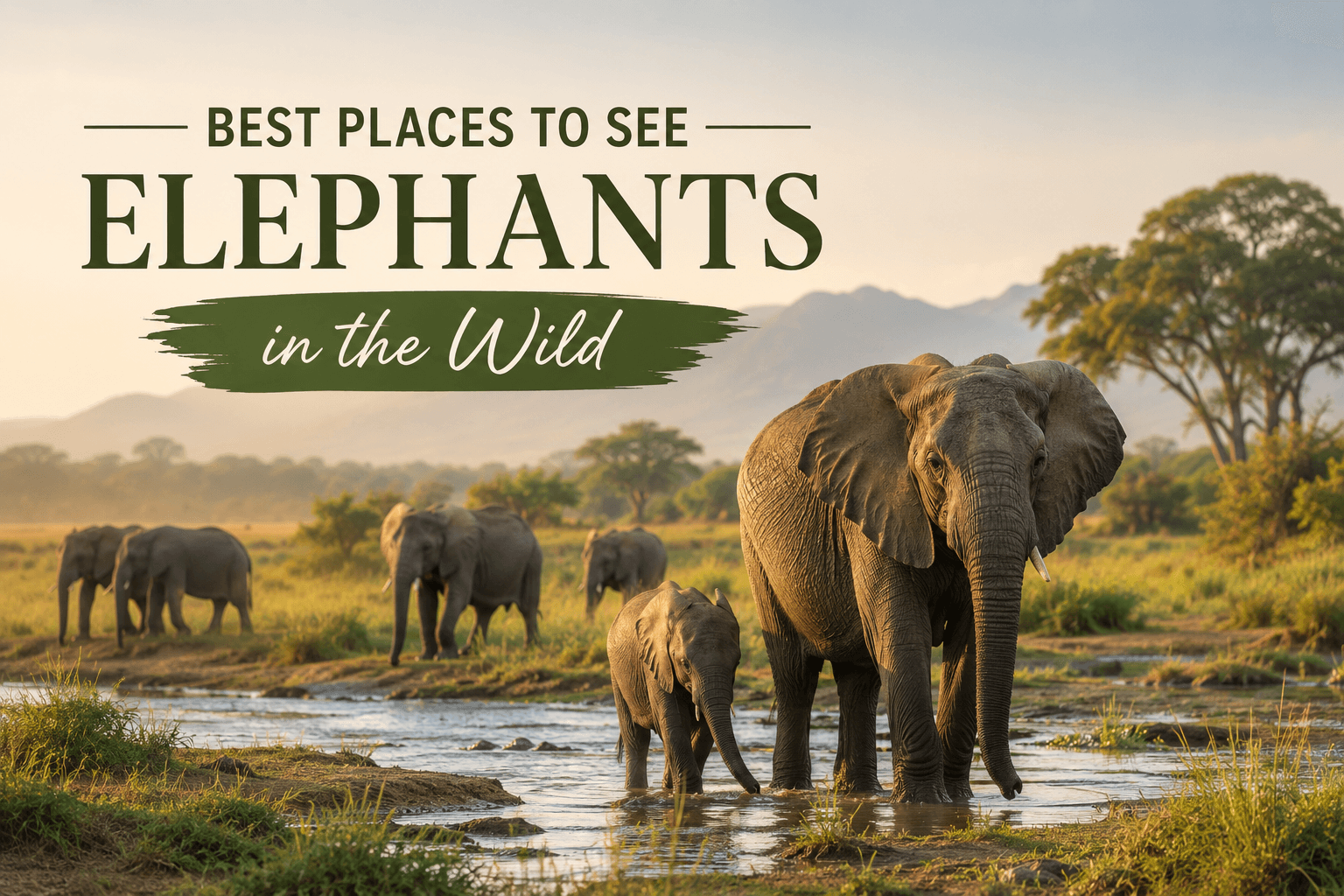
Best Places to See Elephants in the Wild
Sahil 27 May 2026Nature and Wildlife
First time I watched an elephant herd in the wild. I expected the scale. Everyone tells you about the scale. But photographs do not prepare you for the specific experience of standing at the edge of a waterhole in Botswana while a family of twelve elephants, including two calves small enough to walk beneath their mothers, arrives to drink. What the photographs cannot show is the sound. The low, constant rumbling that passes through the herd as they communicate, not quite audible to human ears but felt in the chest. The specific sound of thirty feet moving over dry ground. And the silence that falls over every human in every vehicle when the matriarch turns her head and regards you for a moment before deciding you are not worth her attention.
I spent four hours at that waterhole. Nobody in the vehicle suggested leaving.
Elephants are the most fascinating animals to watch on safari and I will defend that claim against any competition. They are so intelligent, so socially complex, so physically extraordinary in every movement, that you can watch them all day and never exhaust the interest. The matriarch's relationship with her daughters. The young bulls testing their strength. The calves playing in mud. The specific quality of attention that elephants give to strangers, animal and human, which is neither the indifference of a predator who has not noticed you nor the fear of prey, but something that reads unmistakably as consideration.
This guide covers the best places in the world to see elephants in the wild, with the specific practical information that turns an ordinary safari into an extraordinary elephant encounter.
Why Elephants Are Worth Travelling Specifically to See
Elephants are the world's largest land animals. The African bush elephant reaches four metres at the shoulder and weighs up to six tonnes. The Asian elephant is slightly smaller but still the largest land animal on the continent it inhabits. Both species are among the most cognitively sophisticated animals ever to have evolved, with documented evidence of self-recognition, long-term memory, grief behaviour, tool use, and complex social structures that require decades of accumulated knowledge to navigate.
The matriarch of a large elephant herd may be sixty years old. She carries in her memory the locations of water sources, the routes between seasonal grazing areas, and the identities of thousands of individual elephants across her range. This accumulated knowledge is passed to the next generation, which means that the destruction of an elephant family's matriarch through poaching does not just kill one animal. It destroys a library.
Understanding this complexity transforms the experience of watching elephants. You are not watching large animals drink water. You are watching one of the most sophisticated social systems that evolution has produced, navigating daily life in an environment that requires constant decision-making, communication, and the application of multi-generational knowledge.
Best Places to See Elephants in Africa
Chobe National Park, Botswana: The Greatest Elephant Concentration on Earth
Species: African savanna elephant
Estimated population: Approximately 120,000
Best time: July to October (dry season)
Best experience: River cruise and game drive combination
Chobe National Park is a must-visit area with a remarkable concentration of approximately 120,000 elephants. Botswana has the largest population of elephants in Africa and Chobe is easily accessible, is Big Five country, and has a large predator population including wild dog, hyena, leopard, and cheetahs. You cannot go to Chobe National Park and fail to see elephants.
Chobe has huge numbers of elephants, possibly the largest elephant population in Africa, and it is arguably one of the best places in Africa for wild elephant watching.
The specific experience that makes Chobe different from every other elephant destination on earth is the river cruise. The Chobe River forms the northern boundary of the park and during the dry season from July to October, elephant herds of extraordinary size gather along the riverbank to drink, bathe, and cross between Botswana and Namibia.
Watching from a flat-bottomed boat at water level as hundreds of elephants enter the river simultaneously, babies held upstream by the current against their mothers, older animals walking with the specific confidence of creatures who have crossed this river a hundred times, is one of the most dramatic wildlife spectacles available anywhere in Africa.
In July and August at peak season, the Chobe riverfront has thousands of elephants visible at any given moment. The concentration is so extraordinary that it begins to feel like a different category of experience from ordinary wildlife viewing.
The game drive versus river cruise decision: Both deliver excellent elephant encounters but in different ways. Game drives provide access to the park interior where herds are seen in the bush context: family groups at waterholes, bulls in musth, interactions between families at mineral licks. River cruises provide the landscape-scale view of elephants using the river, with the visual drama of large numbers against the open water.
Do both. A morning game drive and an afternoon river cruise on consecutive days is the optimal Chobe itinerary for elephant photography.
The honest note on crowds: Chobe is not a remote destination. The Chobe riverfront area close to Kasane town is well-trafficked during peak season and vehicle concentration at popular elephant sightings can be significant. Staying at camps in the Savuti and Linyanti areas of the park provides access to elephant populations that are equally impressive with dramatically fewer vehicles.
Recommended camp: Sanctuary Chobe Chilwero is a riverside lodge with 15 guest cottages and, notably, the only full spa on the Botswana safari circuit. For the most intimate experience, the camps in the Linyanti Concession north of the park give exclusive access to elephant populations that are less visited than the Chobe riverfront.
Budget range: $400 to $800 per person per day for mid-range camps; $800 to $1,500+ for luxury lodges
Amboseli National Park, Kenya: Elephants with Kilimanjaro
Species: African savanna elephant
Estimated population: Approximately 1,700 to 2,000
Best time: June to October (dry season); January to February for calving
Best experience: Wetland and plains drives with mountain backdrop
Amboseli National Park is the place to come for those iconic images of elephants in front of majestic Mount Kilimanjaro. The elephants of Amboseli have been studied since 1972 and many are individually known.
The specific visual of Amboseli, a family of elephants moving through yellow grass with the snow-capped summit of Kilimanjaro rising 5,895 metres behind them, is one of the most iconic wildlife images on earth. Achieving it requires a clear day (the mountain is frequently obscured by cloud, especially in afternoons) and early morning positioning.
The elephant population here has been studied continuously by the Amboseli Elephant Research Project since 1972, which means these animals are the most extensively documented elephant population in the world and are extremely habituated to vehicles. Some of the elephants you encounter at Amboseli have been known to researchers by name for over fifty years.
The wetlands at the centre of the park, fed by underground springs from Kilimanjaro's snowmelt, attract large elephant herds throughout the day. The combination of the wetland foreground and the mountain background produces the specific Amboseli image that defines the destination.
The famous big-tusked males of Amboseli deserve specific mention. Due to relatively effective anti-poaching protection over decades, Amboseli maintains a population of exceptionally large-tusked males whose tusks in some cases sweep the ground when the animals are standing. Seeing a bull with metre-long tusks is one of those wildlife encounters that produces a physical response of awe that photographs never adequately communicate.
Park fees: $90 per adult per day for non-residents (flat rate year-round) Budget range: $150 to $400 per person per day for mid-range options; $400 to $800 for luxury lodges
South Luangwa National Park, Zambia: Walking Safaris with Elephants
Species: African savanna elephant
Estimated population: 15,000 to 20,000 in the Luangwa Valley
Best time: July to October (dry season)
Best experience: Walking safari and night drive combination
South Luangwa is the jewel in Zambia's crown, scenically beautiful, full of wildlife, and with walking safaris and night drives as optional activities. There are abundant herds of elephant and much elephant activity at the oxbow lakes and river frontage. The elephants often swim across the river. You can watch a whole parade of them, using their trunks as snorkels, the babies bobbing along close behind their mothers.
The Luangwa Valley forms the southern end of the Great Rift Valley and is one of the finest safari destinations. It is traditionally the home of the walking safari and the wildlife viewing is some of the finest in Africa. The Luangwa River, the lifeline during the dry season from May to October, draws in large numbers of elephant and other wildlife from the surrounding area.
South Luangwa is where elephant encounters become genuinely intimate rather than observed from distance. The walking safari tradition here, developed by Norman Carr in the 1950s, allows you to approach elephant herds on foot with an armed guide, covering the last hundred metres on foot in silence. The experience of standing forty metres from a family group on the ground, without the psychological barrier of a vehicle between you, is one of the most viscerally alive wildlife experiences available in Africa.
The river crossings are extraordinary. When a herd decides to cross the Luangwa, which happens multiple times daily during the dry season, the family enters the river in a specific order: the matriarch first, the calves surrounded by adults, the young bulls at the rear. The babies submerge entirely in deeper sections and emerge on the other side with their trunks raised above the water. Watching this from a vehicle parked on the riverbank is one of the finest free spectacles in African wildlife travel.
Recommended camp: Chinzombo and Kapamba camps provide access to the private concessions of the South Luangwa, where walking safaris reach areas that the national park's main safari traffic does not penetrate.
Budget range: $350 to $700 per person per day; luxury private concession camps from $800 to $1,500+
Hwange National Park, Zimbabwe: The Waterhole Experience
Species: African savanna elephant
Estimated population: 45,000 to 50,000
Best time: August to October (end of dry season when waterholes are most critical)
Best experience: Waterhole hide sitting
Hwange has the largest population of elephants in Zimbabwe and the second-largest in southern Africa after Chobe. The park's specific geography, a flat basin far from permanent rivers, means that its wildlife is entirely dependent on artificial waterholes pumped from underground aquifers. During the dry season, these waterholes attract every animal in the area with a reliability that makes viewing predictable rather than dependent on tracking.
The waterhole hide experience at Hwange is specifically worth discussing. Several camps in the park have wooden hides positioned at major waterholes, and guests can spend hours sitting at ground level watching elephants arrive, drink, bathe, and interact at distances as close as five metres. The absence of a vehicle removes the last barrier between observer and animal, and the ground-level perspective, where a six-tonne elephant approaches at eye height rather than from above, produces encounters of extraordinary physical immediacy.
The Mana Pools area of Zimbabwe, about four hours north of Hwange, offers a completely different elephant encounter: elephants that have learned to stand on their hind legs to reach the pods of albida trees that overhang the Zambezi floodplain. The behaviour is genuinely unique, observed only in this specific population, and the sight of a five-tonne animal standing bipedally to reach fruit pods fifteen feet off the ground is one of the most memorable specific animal behaviours available in African wildlife travel.
Budget range: $250 to $600 per person per day for mid-range options
Addo Elephant National Park, South Africa: The Conservation Story
Species: African savanna elephant
Estimated population: Over 600 within the park
Best time: Year-round (good viewing in all seasons)
Best experience: Self-drive safari or guided game drives
Addo Elephant National Park in South Africa offers protected elephant herds and close encounters with local herds. Wild elephants roam freely at Addo, with expert guides sharing insights about conservation efforts.
Addo's story is one of conservation's genuine success narratives. By 1931, the park's elephant population had been reduced to eleven individuals through hunting. The establishment of the national park and decades of protection have grown this population to over 600, which is a remarkable recovery that the park openly discusses as part of every visitor experience.
The compact size of the park's original section means elephant sightings are virtually guaranteed, and the habituation of these animals to vehicles is exceptional. Addo is accessible by self-drive safari, making it one of the few African elephant destinations that budget travellers can experience independently without a guided safari package. The MalaMala and private reserves bordering Addo provide luxury options for those who want a more pampered experience.
For South Africa visitors who are combining an elephant experience with the Garden Route, Cape Town, or the Winelands, Addo's proximity to Port Elizabeth and its self-drive accessibility make it the most practical elephant safari destination in the country.
Park entry fee: Approximately $18 per adult per day
Budget range: Self-drive from $80 per person per day (accommodation plus park fees); guided safari from $250 to $500 per person per day
Samburu National Reserve, Kenya: The Northern Frontier Elephants
The rugged Samburu, lying on the edge of Kenya's northern frontier, is an ideal area to see elephants as they are drawn to the waters of the Ewaso Ngiro River.
Samburu's elephants are specific to the arid north of Kenya and the combination of their semi-desert environment, the Ewaso Ngiro River, and the extraordinary biodiversity of the Samburu Special Five (species found in northern Kenya but not in the southern parks) makes Samburu the most interesting elephant destination for travellers who have already done Amboseli and want something genuinely different.
The elephants here use the river as their primary water source, and watching large family groups arrive at the river through the palm-lined banks while the Samburu hills rise in the background is one of northern Kenya's most atmospheric wildlife experiences.
Best Places to See Asian Elephants in the Wild
Kabini and Nagarhole, Karnataka, India: The River Crossing Spectacle
Species: Asian elephant
Estimated population: 6,000+ in the Karnataka elephant population
Best time: March to June (dry season)
Best experience: Morning boat safari on Kabini reservoir
India holds approximately 60 percent of the world's remaining Asian elephant population, and the Kabini River area bordering Nagarhole National Park provides the most dramatic and most accessible viewing in the country.
During March to June, as the water sources within the forest dry up, elephants converge on the Kabini reservoir in numbers that make the bank crossings one of the most spectacular large mammal events available in Asia. Herds of fifty to one hundred elephants arrive at the water twice daily, and the morning boat safaris that position visitors at water level during these crossings produce encounters of extraordinary intimacy.
The Asian elephant is physically different from its African counterpart in ways that matter to the viewing experience. Smaller ears, a more rounded back, and calves that appear almost comically small relative to the adults. The family structure and social complexity are comparable to the African species, but the forest environment of South India means the encounters are frequently through vegetation rather than in open landscape, which produces a different quality of visibility but a more immersive sense of being in the animals' habitat.
The Dubare Elephant Camp: A forest department-managed camp on the Kaveri River where semi-wild elephants from the Nagarhole forests come for daily bathing. The interaction here is genuine rather than performance-based, and the morning bathing sessions at 8:30am are open to visitors for approximately 500 rupees. This is not the wild elephant experience of a boat safari at Kabini, but it is an extraordinary close encounter with Asian elephants in a river setting.
Best accommodation: Orange County and Evolve Back Kuruba Safari Lodge are the finest wildlife lodges at Kabini, both providing exclusive boat safari access and naturalist guides with deep knowledge of individual elephants.
Budget range: $150 to $400 per person per day for mid-range lodges; $400 to $800 for luxury options
Sri Lanka's Minneriya and Kaudulla National Parks: The Gathering
Species: Sri Lankan elephant (subspecies of Asian elephant)
Estimated population: 5,000 to 6,000 on the island
Best time: August to October
Best experience: The Gathering at Minneriya Tank
Sri Lanka's Gathering is Asia's version of Chobe in terms of elephant concentration spectacle. Every August to October, as the water level drops in Minneriya and Kaudulla tanks (ancient irrigation reservoirs from the 2nd century BC), hundreds of elephants converge on the exposed grass flats to graze. The Gathering at peak season produces concentrations of 300 to 500 elephants visible simultaneously, the largest concentration of Asian elephants anywhere in the world.
The Gathering is specifically a family event. Bulls, cow groups, and their calves arrive from across the dry zone forests surrounding the tanks, and the interactions between different family groups, the specific social politics of which families drink where and who gives way to whom at the water edge, are fascinating to watch over multiple hours.
Sri Lanka's accessibility from South Asia and Southeast Asia, combined with the island's extraordinary cultural heritage (Sigiriya, Dambulla, the Temple of the Tooth), makes combining The Gathering with a broader Sri Lanka cultural itinerary one of the most rewarding wildlife-plus-culture combinations available in Asia.
Best base: Habarana, a small town with multiple accommodation options within 20 to 30 minutes of both Minneriya and Kaudulla.
Budget range: $50 to $200 per person per day for accommodation; park entry fees approximately $15 to $30 per adult
Jim Corbett National Park, India: Himalayan Elephant Herds
Species: Asian elephant
Estimated population: Part of the 1,069 elephants in the Terai arc landscape
Best time: November to June
Best experience: Dhikala zone game drives and river areas
Corbett's elephant population, part of the Terai arc elephant population that moves between India and Nepal, is seen in a context that is completely different from the South Indian experience. These are hill forest elephants, moving through sal and mixed forest in the foothills of the Himalayas, sometimes encountered in herds of over one hundred animals during the dry season when they concentrate along the Ramganga River.
The specific experience of Corbett's elephant encounters is their scale relative to the landscape. The Dhikala meadow, a large grassland clearing in the centre of the park, sometimes hosts elephant herds of extraordinary size that emerge from the forest edge at dawn. Watching one hundred Asian elephants process across a grassland in the first light, with the Himalayan foothills visible behind them, is one of those wildlife moments that does not exist in Africa and represents a genuinely distinct version of elephant travel.
Budget range: $200 to $600 per person per day depending on accommodation
Elephant Destination Comparison Guide
Destination | Species | Best Season | Herd Size | Unique Experience | Daily Budget |
|---|---|---|---|---|---|
Chobe, Botswana | African savanna | July to Oct | Hundreds to thousands | River cruise with mass herds | $400 to $1,500 |
Amboseli, Kenya | African savanna | June to Oct | 10 to 50 per herd | Big-tusked bulls, Kilimanjaro backdrop | $150 to $800 |
South Luangwa, Zambia | African savanna | July to Oct | 20 to 100 | Walking safari, river crossings | $350 to $1,500 |
Hwange, Zimbabwe | African savanna | Aug to Oct | 50 to 200 at waterholes | Waterhole hides, Mana Pools hind-leg behaviour | $250 to $800 |
Addo, South Africa | African savanna | Year-round | 10 to 40 | Self-drive accessible, conservation story | $80 to $500 |
Kabini, India | Asian elephant | March to June | 20 to 100 at river | Boat safari, river crossings | $150 to $800 |
Minneriya, Sri Lanka | Sri Lankan elephant | Aug to Oct | 300 to 500 | The Gathering, largest Asian elephant event | $50 to $200 |
Jim Corbett, India | Asian elephant | Nov to June | 50 to 100+ | Himalayan foothill setting, mass herds | $200 to $600 |
The Ethics of Elephant Tourism
This section is not optional reading. It is the foundation of responsible engagement with elephant tourism.
The elephant tourism industry contains a broad spectrum of ethical practice, from exemplary conservation-linked wildlife viewing at the destinations in this guide to deeply problematic captive elephant attractions where animals are kept in poor conditions and subjected to stress for commercial entertainment.
The ethical standard for wild elephant encounters: All the destinations in this guide involve genuinely wild elephants in their natural habitat, observed from vehicles, boats, or on foot at appropriate distances with skilled guides. This is the correct form of elephant tourism.
What to avoid: Elephant riding in any context. The process of breaking an elephant for riding, called phajaan in Thai, involves physical confinement and stress that is documented to cause lasting psychological damage. This applies equally to forest camps in India, sanctuary operations in Thailand, and tourist attractions across Asia regardless of how the operation markets itself.
Elephant bathing experiences where animals are required to stand in water with tourists, regardless of the claimed rescue backstory of the operation.
Any attraction that has elephants performing tricks, painting, dancing, or producing artwork for tourists.
The distinction for conservation facilities: Some organisations in range countries run genuine elephant rehabilitation and welfare programmes that provide valuable conservation work. The Sheldrick Wildlife Trust in Kenya, which rescues orphaned elephants and rehabilitates them for eventual release into the wild, is the gold standard. Supporting operations that are specifically oriented toward eventual wild release rather than permanent captivity is the appropriate engagement with elephant conservation tourism.
Expert Tips for the Best Elephant Encounters
Go in the dry season, specifically toward its end. The best time to travel to Africa to see elephants is in the dry season, usually anywhere from April to October. The final weeks of the dry season, September and October in southern Africa, produce the highest elephant concentrations at water sources as the dry conditions become most extreme. The quality and intensity of waterhole encounters in late September at Chobe or Hwange exceeds what the same locations deliver in July.
Spend more time at fewer locations. The temptation to cover multiple parks in a week produces game drive exhaustion and reduces the quality of each individual encounter. Three nights at a single excellent elephant destination produces better encounters than one night each at three destinations. Elephants take time to find and their behaviour reveals itself slowly. Four hours at a waterhole is more instructive than four separate one-hour game drives.
Hire a guide with individual animal knowledge. The guides at the best Amboseli camps know individual elephants by name and can tell you the family history of the matriarch walking toward your vehicle. This specific knowledge transforms an elephant sighting from a wildlife encounter into a meeting with a specific individual whose story you now partially know. The difference is genuinely significant.
Take a boat safari at Chobe or Kabini. The water-level perspective on elephants is fundamentally different from the vehicle-level perspective. At water level, the animals appear at their actual scale rather than being viewed from above, and the specific encounters at river crossings and bathing sites are simply not accessible from a land vehicle.
Photography: For elephant photography specifically, morning light is front-lit from the east and produces the warm tones that make dust and water photographs work. The specific moment when an elephant flaps its ears while standing in bright morning light, with dust moving around it, is the image that elephant photography is largely organised around producing. Position for east-facing viewpoints in morning hours. At waterholes, ask your guide to position for the light rather than the proximity.
Mistakes Elephant Watchers Make
Arriving at the Amboseli viewpoints in the afternoon expecting Kilimanjaro. The mountain generates its own weather and is frequently cloud-covered by noon or 1pm. The specific image of elephants with Kilimanjaro requires morning positioning, specifically the hour after sunrise when the mountain is clearest and the light is at its best. Plan your Amboseli game drives to begin at dawn and prioritise the mountain-facing positions in the first two hours.
Staying only in the tourist zone at Chobe. The Chobe riverfront near Kasane is excellent but busy. The Savuti and Linyanti areas of the park, accessible by light aircraft or long drive from Kasane, have equally impressive elephant populations with a fraction of the vehicle density. If your Chobe budget allows the extra transfer, these areas produce a quality of experience that the riverfront cannot match for remoteness and intimacy.
Not allowing enough time for walking safaris in South Luangwa. The walking safari is not a substitute activity when the game drive returns without a significant sighting. It is a completely different engagement with the same ecosystem. Book specifically for walking safaris at South Luangwa and allocate minimum two mornings to the activity. The third morning is usually when everything learned in the first two becomes fluent enough to produce the genuinely intimate encounter.
Expecting Asian and African elephant encounters to be interchangeable. They are not. The habitat differences, behavioural differences, and viewing situation differences between watching African elephants at an open waterhole in Botswana and watching Asian elephants emerge from dense forest at a Kerala river are significant enough to constitute genuinely different wildlife travel experiences. Both are extraordinary. Neither substitutes for the other.
FAQ: Best Places to See Elephants in the Wild
Which country has the most elephants in the wild?
Botswana has the largest population of elephants in Africa, with approximately 130,000 elephants. Chobe National Park within Botswana has a remarkable concentration of approximately 120,000 elephants, the largest in Africa. Zimbabwe, Tanzania, and Kenya follow as the other major elephant population strongholds in Africa. For Asian elephants, India holds approximately 60 percent of the world's remaining population with an estimated 27,000 to 30,000 individuals.
What is the best month to see elephants?
The dry season is consistently the best window across all elephant destinations. For southern Africa (Botswana, Zimbabwe, Zambia), July to October is the peak season. For East Africa (Kenya, Tanzania), June to October is optimal. For South India and Sri Lanka, March to June for Kabini and August to October for Sri Lanka's Gathering. In all cases, the end of the dry season produces the highest concentrations at water sources.
Is it better to see African or Asian elephants?
They are different experiences that complement rather than compete with each other. African elephants are larger, found in more open habitats that make viewing easier, and the best African destinations (Chobe, Amboseli, South Luangwa) have denser populations and more established tourism infrastructure. Asian elephant encounters tend to be more intimate due to forest habitat, the animals are slightly smaller, and the cultural context in countries like India and Sri Lanka adds a layer of historical and spiritual significance to the encounter. Serious elephant travellers eventually seek both.
What is the most ethical way to see elephants?
Wild elephant viewing at reputable game parks and reserves, with licensed operators who maintain appropriate distances and follow park regulations, is the most ethical form of elephant tourism. This applies to all destinations in this guide. Elephant riding, captive bathing experiences, and any performance-based elephant attraction should be avoided entirely. For specific conservation engagement, supporting the Sheldrick Wildlife Trust in Kenya or equivalent rehabilitation organisations provides a meaningful contribution alongside any safari visit.
How close do you get to elephants on a wild safari?
Distances vary by destination and the elephants' habituation to vehicles. At Amboseli, game drive vehicles routinely come within 10 to 15 metres of elephant herds without any stress response from the animals. At South Luangwa on walking safari, trained guides approach habituated herds to within 30 to 50 metres on foot. At Chobe riverfront during river crossings, boat-based viewing can be within 5 to 10 metres of swimming animals. The key in all cases is working with experienced guides who understand the specific behaviour of the animals in their territory and who never push beyond the comfort zone of the herd.
The Final Word
There is a moment in elephant watching that I keep coming back to.
It happens somewhere in the middle of a long session at a waterhole or a river. The specific moment when you stop analysing the behaviour and stop planning the photograph and simply watch. When the matriarch turns and begins to walk and the entire family, without any visible signal, begins to move with her in the same direction. The calves find their position between the adults. The older juveniles shift to the edges of the group. The whole unit moves as a single organism with fourteen hearts and forty years of accumulated knowledge at its centre.
Nothing in wildlife travel has given me more to think about for longer than the time I have spent watching elephants. Not because the encounters are the most dramatic available in nature, though some of them are. Because the animals give you so much to see. They are endlessly specific, endlessly social, endlessly revealing of something about intelligence and memory and family and grief that feels less like watching wildlife and more like watching a version of consciousness that is genuinely different from our own and genuinely equivalent in its depth.
Go find the matriarch. Let her decide whether you are worth her attention.
If she turns toward you, hold completely still.
All park fees and accommodation costs are approximate and based on 2026 data. All elephant tourism in this guide involves genuinely wild animals in protected habitats. Elephant riding and captive performance attractions are not endorsed or recommended under any circumstances.