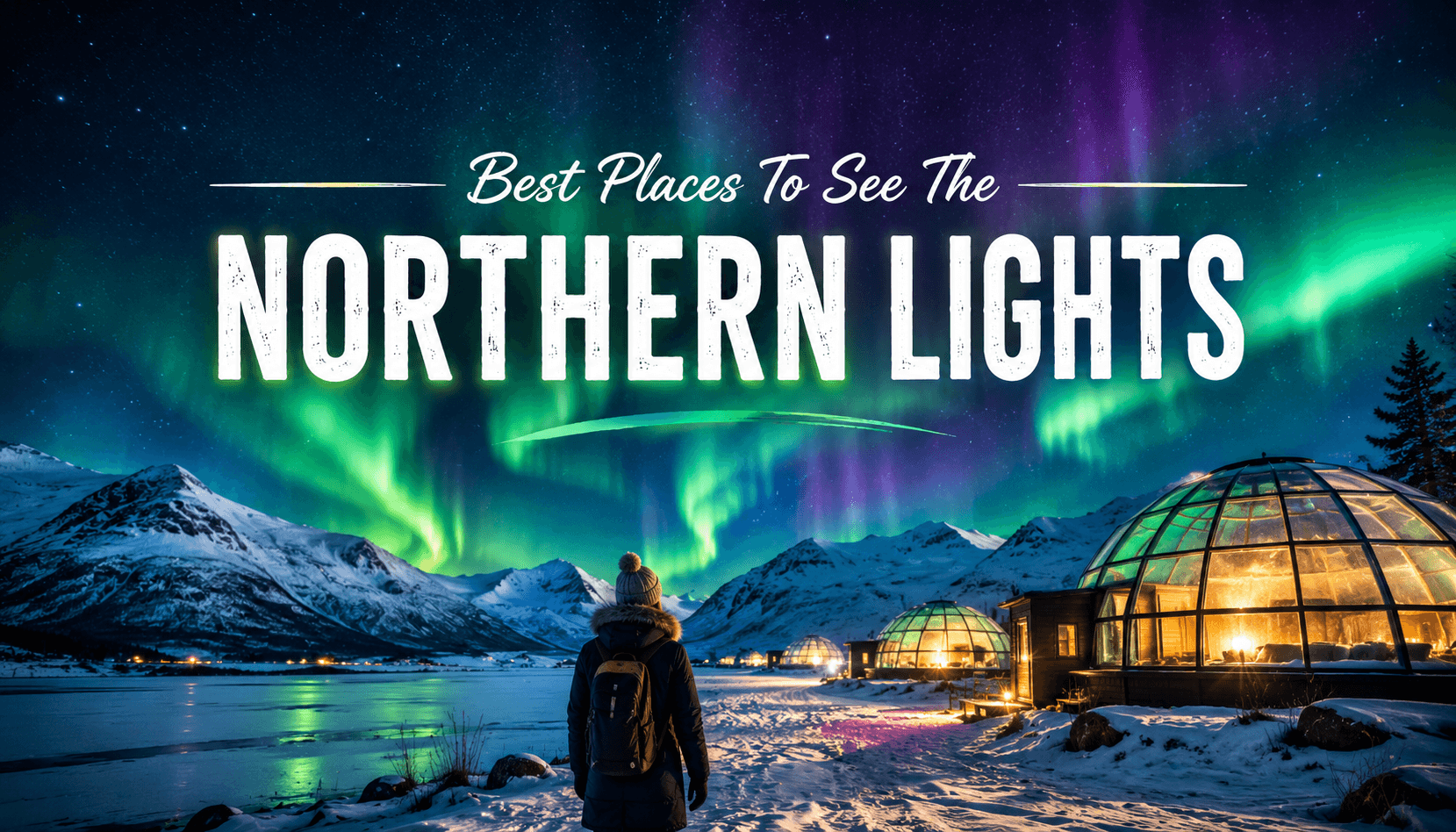
Best Places To See The Northern Lights
Arthur Bennett 12 May 2026Travel
There are some moments in travel that words do not do justice to. The northern lights is one of them. I have stood in a snow-covered field in Norway at 11pm, temperature somewhere around minus fifteen, fingers going numb inside three layers of gloves, watching a green curtain of light ripple across the entire sky like the universe was breathing. No camera I own has ever captured it correctly. The colours are brighter, the movement is faster, and the silence around it is something photographs cannot hold.
That night changed how I think about natural wonders. Because nothing I had ever seen on a screen, in a documentary, or in another person's photograph had prepared me for what the aurora borealis actually looks like when you are standing underneath it. If seeing the northern lights is on your bucket list, this guide will help you plan the trip properly. Not with vague suggestions, but with specific destinations, honest costs, the best months to go, and the practical tips that actually make the difference between getting lucky and going home empty-handed.
What Are The Northern Lights and Why Do People Travel So Far To See Them?
The northern lights are shimmering light displays caused by particles from the sun colliding with Earth's atmosphere. Most often they appear as green waves across the night sky, but shades of purple, red, and pink can also be seen. The name Aurora Borealis comes from the Roman goddess of dawn, Aurora, and the Greek word for north wind, Boreas. While science explains the phenomenon, ancient myths across the Arctic told stories of spirits, warriors, and omens dancing above.
The Vikings believed the lights were reflections from the shields of the Valkyries. The Sami people of Lapland call the lights "revontulet" or "fire fox." They believed an Arctic fox racing through the mountains swept its tail across the snow, sending sparks into the sky. For the Inuit of Greenland, the lights represented the spirits of the dead playing a game with a walrus skull. The reason people travel thousands of miles to see them is not complicated. You can watch a video of the northern lights and feel nothing. You can see a photograph and think it is beautiful. Then you see them in person and you understand immediately why people cry.
What Causes The Northern Lights?
The northern lights form when charged particles from the sun, known as solar wind, collide with Earth's atmosphere. As these particles interact with oxygen and nitrogen, they release energy in the form of light, creating spectacular displays of shimmering curtains, dynamic spirals, or arcs in colours like green, purple, red, and blue. Oxygen produces greens and reds, and nitrogen creates purples, blues, and pinks. The various shapes are influenced by Earth's magnetic field.
The different colours in the northern lights are caused by solar particles colliding with various gases at different altitudes. Green, the most common colour, occurs when particles hit oxygen at lower altitudes around 60 to 150 miles up. Red appears at higher altitudes above 150 miles and is more common during strong displays in Alaska or northern Canada. To witness the aurora, you must travel to the auroral zone, a band around the magnetic North Pole between 60 and 70 degrees latitude, encompassing Alaska, Canada, southern Greenland, Iceland, and Northern Scandinavia.
Best Time To See The Northern Lights
The aurora season runs from September to March, with the darkest months from October to February offering the most consistent nights. Generally, 10pm to 2am is the best time to see the northern lights. Aurora activity tends to peak around midnight, when the solar wind is most active and the Earth is in the best position to receive it.
Here is the honest breakdown by month:
September: Early season. Equinox boosts activity. Great combination of aurora and autumn colours.
October to November: Darker nights, strong activity, fewer tourists than peak months.
December to January: Longest nights but often cloudy. Best for glass igloo bookings.
February to March: Often the clearest skies. Equinox again increases activity. Best overall window.
April: Season winds down but still possible in peak locations.
The spring and fall equinoxes around March 20 and September 22 are prime time for aurora activity. Many experienced aurora chasers consider February and March the single best window, balancing darkness, cloud probability, and solar activity.
2026 Solar Outlook: We are currently in a post-solar maximum period with turbulent space weather still driving strong auroras, making 2026 an excellent year for aurora viewing. In plain terms: the sun is still very active and displays are more frequent and more dramatic than in quiet years.
Understanding The KP Index: The Number Every Aurora Chaser Needs To Know
The KP index measures the strength of geomagnetic activity on a scale of 0 to 9. The higher the number, the more powerful and widespread the aurora.
KP 1 to 3: Visible in the Arctic Circle on dark, clear nights
KP 4 to 5: Visible further south, including northern Scotland
KP 7 to 9: Visible across large parts of Europe, Canada, and the northern USA
For Arctic destinations like Norway, Iceland, and Finland, a KP3 index is usually enough to see the lights. Scotland's Shetland Islands require stronger activity at KP8 to 9 because they are at a lower latitude. The best apps for tracking aurora activity: My Aurora Forecast, Space Weather Live, and NOAA Space Weather Prediction Center. Download one before you travel and check it every evening from 9pm onwards.
Best Places To See The Northern Lights In 2026
1. Norway: The Best Overall Destination for Aurora Borealis Travel
Norway is the most iconic destination for the northern lights, with spectacular fjords and some of the world's best aurora conditions. Tromsø is known as the Gateway to the Arctic, and its accessibility, vibrant city life, and surrounding wilderness make it an ideal base for aurora chasers. Alta is known as the City of the Northern Lights and has a long history of aurora research, offering clear skies and dry conditions, several hotels designed for aurora viewing including glass igloos. The Lofoten Islands are renowned for their dramatic landscapes with rugged peaks, fjords, and picturesque fishing villages, making them the perfect setting for aurora viewing.
Best viewing spots:
Tromsø: Most accessible, aurora tours depart nightly
Lofoten Islands: Most photogenic, aurora over fjords and wooden fishing huts
Alta: Driest conditions, glass igloo hotels, aurora research centre
Svalbard: Located between the 74th and 81st parallels north, Svalbard is closer to the North Pole than it is to Norway, making it a great place for northern lights viewing.
Best months: September to March
Budget range: $150 to $250 per day including accommodation, food, and one guided tour Activities beyond aurora: Dog sledding, whale watching (November to January in Tromsø), snowshoeing, fjord cruises
Expert tip: Book a chase tour rather than waiting at your hotel. Tromsø operators chase breaks in the cloud cover by driving inland, and the difference in success rate between waiting and chasing is enormous.
2. Iceland: Volcano, Ice, and Aurora in One Country
Iceland has an unfair advantage over every other aurora destination: the scenery is so extraordinary that even a cloudy night without lights leaves you with memories worth the trip. Iceland's rugged, volcanic terrain feels tailor-made for the aurora. While you can sometimes spot the lights from Reykjavík by finding a dark corner, the best views are found along the coast. Þingvellir National Park, the Jökulsárlón glacier lagoon where lights reflect off floating icebergs, and the iconic Mount Kirkjufell are all bucket-list locations for photographers.
The best months to visit Iceland for aurora sightings are September and March, when temperatures range from 1 to 6 degrees Celsius.
Best viewing spots:
Jökulsárlón Glacier Lagoon: Auroras reflected in floating icebergs is a once-in-a-lifetime image
Kirkjufell Mountain on Snæfellsnes Peninsula: The most photographed aurora spot in Iceland
Þingvellir National Park: UNESCO site, zero light pollution
Vík: Black sand beaches under the lights
Best months: September to March
Budget range: $180 to $300 per day. Iceland is expensive, but self-driving the Ring Road keeps costs manageable.
Activities beyond aurora: Blue Lagoon, Golden Circle, glacier hiking, waterfalls
Practical note: A five-night journey to Iceland's south coast gives you aurora-friendly locations along with Thingvellir, Reykjavik, Gullfoss, Diamond Beach, and the Blue Lagoon. The south coast is the most efficient route for combining natural attractions with northern lights hunting.
3. Finland: Glass Igloos, Reindeer, and Lapland Magic
Finnish Lapland is where aurora travel meets genuine fairytale atmosphere. The combination of reindeer farms, log cabin saunas, snow-covered pine forests, and glass igloo hotels creates an experience that feels completely unlike anywhere else on earth. Finnish Lapland is famous for its aurora viewing opportunities thanks to its vast wilderness, dark skies, and high-latitude viewpoints. Glass igloos in Rovaniemi and Kakslauttanen offer warmth and unobstructed skies.
Best viewing spots:
Kakslauttanen Arctic Resort: The original glass igloo hotel, the most famous aurora accommodation in the world
Saariselkä: Remote Lapland village with consistently dark skies
Luosto: Small, quiet, excellent visibility
Rovaniemi: Santa Claus Village is also conveniently close to the Arctic Circle
Best months: November to March
Budget range: From $130 per day for standard accommodation; glass igloo nights start from $300 to $700
Activities beyond aurora: Reindeer sleigh rides, husky safaris, ice fishing, sauna culture, visiting Santa Claus Village in December
Honest note: Finnish Lapland is slightly cloudier than Norwegian destinations and Canadian options. Plan a minimum of five nights to ensure enough clear windows.
4. Sweden: The Aurora Sky Station and Quieter Crowds
Sweden sits between Norway and Finland in terms of both geography and atmosphere, and it has one specific aurora asset that neither country can match: the Abisko Aurora Sky Station. Northern Norway and Sweden combine fjord views with strong aurora activity. Abisko in Sweden is known for its microclimate that keeps it clearer than surrounding areas, and the Aurora Sky Station here has some of the highest aurora sighting rates in Scandinavia.
Best viewing spots:
Abisko National Park: Microclimate makes it statistically the clearest location in Scandinavia
Aurora Sky Station: Chairlift access to the station above the clouds
Kiruna: Icehotel and nearby wilderness
Gällivare: Less touristy alternative with good dark sky access
Best months: November to March
Budget range: $140 to $220 per day
Activities beyond aurora: Icehotel experience in Kiruna, snowmobile tours, ice sculpting, Sami cultural experiences
During strong displays in Abisko, the aurora is clearly visible without any equipment, typically appearing as green ribbons or curtains with occasional hints of purple, red, or blue.
5. Alaska: The Best Northern Lights Destination in North America
For American travellers, Alaska is the most logical starting point for aurora borealis travel. No passport required, direct flights from Seattle and Los Angeles, and conditions that rival anywhere in Scandinavia. Located directly under the auroral oval in central Alaska, Fairbanks is one of the best places on Earth to see the northern lights, with consistent activity and a long aurora season from August to April, dark skies, and minimal light pollution. Expansive ice fields, towering mountain ranges, and plunging river canyons make Alaska jaw-droppingly scenic. A sighting of the northern lights here creates a truly unforgettable trip.
Best viewing spots:
Fairbanks: Sits directly under the auroral oval. Consistently the highest sighting rates in the USA
Denali National Park: Perched on an isolated nunatak overlooking Denali National Park at 6,000 feet above sea level, this is one of the best places to see the northern lights in Alaska.
Chena Hot Springs: Aurora viewing from outdoor hot springs at midnight. Genuinely extraordinary.
Coldfoot: Remote, minimal light pollution, off the beaten path
Best months: Late August to April
Budget range: Alaska tour packages start from $4,060 for six days excluding flights
Activities beyond aurora: Dog mushing, snowshoeing, wildlife viewing, gold panning, visits to Denali
Honest note on tours: Northern lights tours in Fairbanks start at $120 per person for guided evening excursions. These are well worth taking on your first nights to learn the viewing locations before exploring independently.
6. Canada: Yellowknife and the Aurora Capital of North America
Yellowknife in Canada's Northwest Territories is often called the Aurora Capital of the World due to its flat landscape and exceptionally high sighting rates.
What makes Yellowknife special is geography. The flat Precambrian Shield landscape means there are zero mountains or hills to block the view in any direction. When the aurora appears, it fills the entire sky from horizon to horizon. Nothing else in the aurora world quite compares to that 360-degree experience.
Best viewing spots:
Yellowknife (Northwest Territories): Best sighting rates in Canada
Whitehorse (Yukon): Beautiful scenery, multiple tours available
Churchill (Manitoba): The shores of Hudson Bay offer excellent aurora conditions from November to January. Also the polar bear capital of the world.
Best months: November to January for darkest conditions; September and March for equinox activity
Budget range: Canada tours start from $627 for four days excluding flights
Activities beyond aurora: Polar bear watching in Churchill, snowmobiling, Indigenous cultural experiences, ice road tours.
7. Greenland: Remote, Wild, and Completely Uncrowded
Greenland is the aurora destination for travellers who want the full wilderness experience without a tour group in sight. The lights here appear over glaciers and ice sheets that cover 80 percent of the island, creating some of the most dramatic aurora backdrops on earth.
The trade-off is logistics. Greenland is not easy or cheap to reach. Most visitors fly via Copenhagen or Reykjavik, and internal travel requires small propeller planes between settlements.
Best viewing spots:
Kangerlussuaq: Sits in a natural fjord with some of the clearest skies in the Arctic
Ilulissat: Aurora over UNESCO-listed Ilulissat Icefjord
Nuuk: The world's smallest capital, with good aurora access from the surrounding wilderness
Best months: October to March
Budget range: High. Greenland is one of the most expensive northern lights destinations. Budget $300 to $500+ per day all in.
Best for: Serious aurora chasers and adventure travellers who have already visited Norway or Iceland
Honest note: Greenland's weather can be stormy in winter, resulting in skies that obscure the lights, so it tends to be more unpredictable for northern lights viewing than Norway, Iceland, and Canada. Go with realistic expectations and a minimum of six nights.
8. Scotland: The Surprise Aurora Destination in the UK
Scotland does not have the same aurora credentials as the Scandinavian countries, and honesty requires saying that. But during strong geomagnetic events, the northern lights appear regularly over the Scottish Highlands and islands, and the combination of castles, lochs, and aurora is genuinely extraordinary.
Scotland's Shetland Islands require stronger activity at KP8 to 9 to see the lights because they are at a lower latitude. Orkney and the Outer Hebrides offer better chances than mainland Scotland.
Best viewing spots:
Shetland Islands: Closest Scottish territory to the auroral oval
Orkney Islands: Minimal light pollution, dramatic landscape
Cairngorms National Park: Best mainland option on clear, high-KP nights
Cape Wrath: Remote northern tip, excellent dark skies
Best months: October to March during high solar activity
Budget range: $100 to $180 per day, significantly cheaper than Scandinavia
Best for: Travellers who want to combine aurora hunting with a broader Scotland trip
Honest note: Scotland is a bonus destination, not a primary one. If seeing the northern lights is the main point of your trip, go to Norway or Iceland first. If you are already planning a Scotland trip and want to maximise your chances, get to Shetland in November and keep one eye on the KP index.
Northern Lights Destination Comparison Table
Destination | Best Months | Tour Cost | Visibility | Best For | Difficulty |
Norway (Tromsø, Lofoten) | Sep to Mar | $150 to $250/day | Excellent | First-timers, photography | Easy |
Iceland | Sep to Mar | $180 to $300/day | Very Good | Scenery + aurora combo | Easy |
Finland (Lapland) | Nov to Mar | $130 to $300/day | Good to Very Good | Glass igloos, family | Easy |
Sweden (Abisko) | Nov to Mar | $140 to $220/day | Excellent (microclimate) | Serious aurora chasers | Easy |
Alaska (Fairbanks) | Aug to Apr | $4,000+ per trip | Excellent | US travellers, adventure | Moderate |
Canada (Yellowknife) | Sep to Mar | $627+ per trip | Outstanding | 360-degree sky views | Moderate |
Greenland | Oct to Mar | $300 to $500+/day | Variable | Remote wilderness seekers | Difficult |
Scotland | Oct to Mar | $100 to $180/day | Unpredictable | Budget, UK based | Easy |
What To Pack For Northern Lights Travel
Getting cold standing in a snowy field at midnight is not just uncomfortable. It is the reason many people give up waiting too early and miss the lights by twenty minutes.
Essential clothing layers:
Base layer: Merino wool thermal top and bottoms
Mid layer: Fleece or down jacket
Outer layer: Windproof and waterproof shell jacket and trousers
Wool or fleece-lined trousers over your base layer
Thermal socks: Two pairs, wool outer
Waterproof snow boots rated to at least minus 20 degrees Celsius
Insulated gloves or mittens plus a liner glove underneath
Balaclava or neck gaiter: Face exposure at minus 15 is genuinely painful
Hand warmers: Chemical heat packs that slip into gloves. Buy a box.
Essential equipment:
Camera with manual mode capability (mirrorless or DSLR preferred)
Wide-angle lens with an aperture of f/2.8 or wider
Sturdy tripod: Essential for long exposure aurora shots
Extra camera batteries: Cold drains them fast. Keep spares inside your jacket
Headlamp with red light mode to preserve night vision
Thermos of hot tea or coffee
Aurora forecast app downloaded and set up before you land
Aurora Photography Tips: How To Actually Capture What You See
The most common photography mistake on aurora trips is using auto mode. The camera does not know how to handle a dark sky with moving light. You need full manual control.
Basic settings to start with:
Aperture: f/2.8 or as wide as your lens allows
ISO: 800 to 3200 depending on light intensity
Shutter speed: 5 to 25 seconds (shorter for fast-moving aurora)
Focus: Manual focus set to infinity (turn autofocus off completely)
File format: RAW if possible for maximum editing flexibility
The tip most guides skip: Focus your lens on a bright star before the aurora appears. Stars are at infinity. Once your star is sharp, lock the focus ring with tape so it does not shift when you handle the camera in the cold.
For beginners, the Aurora HDR app or Lightroom mobile can significantly improve your shots during the editing phase even from a smartphone. Take more shots than you think you need. Aurora displays that look faint to the naked eye often appear vivid in a 15-second exposure.
Budget vs. Luxury: Northern Lights Trips for Every Wallet
Budget northern lights trip ($80 to $150 per day):
Fly to Tromsø or Reykjavik on budget airlines
Stay in a hostel or budget guesthouse outside the main tourist centre
Join one group aurora chase tour ($50 to $80 per person)
Self-drive using a rental car for independent dark sky access
Cook your own meals from supermarkets
Mid-range trip ($150 to $300 per day):
Private apartment or three-star hotel
Two to three guided evening tours across your stay
Breakfast included at accommodation
One activity per day such as snowshoeing or dog sledding
Luxury trip ($400 to $1,000+ per day):
Glass igloo or aurora cabin with private hot tub
Private guided aurora chases with a dedicated photographer-guide
Reindeer sleigh rides, private snowmobile tours, helicopter excursions
Full-board meals with local arctic cuisine
Spa facilities and recovery treatments between evening activities
The most important luxury investment at any budget level is time. The golden rule of aurora hunting is patience: plan a stay of at least four to five nights to account for weather fluctuations and maximise your sighting chances. Spending more on extra nights is a better investment than spending it on a single glass igloo.
Tips for First-Time Northern Lights Travellers
Book for at least five nights minimum
Planning to stay at least three nights in a viewing locale greatly improves your odds and reduces the risk of missing them due to unfavourable conditions. Five to seven nights is better. The aurora does not perform on a schedule.
Get away from cities
Even small towns create enough light pollution to wash out a KP3 to 4 display. Drive or take a tour to genuinely dark skies at least 30 minutes from any settlement.
Download aurora forecast apps before you land
Forecasts to follow include the NOAA Space Weather Prediction Center and Spaceweather.com. Most apps provide three-day forecasts with updates on aurora activity and real-time auroral oval maps.
Ask your accommodation about wake-up calls
Most hotels and lodges provide wake-up calls when the aurora appears, so you never miss a display. Request this service on arrival. The best displays often happen at 1am when you have given up and gone to bed.
Watch the weather forecast as carefully as the aurora forecast
A KP8 display means nothing if the sky above you is completely overcast. Cloud cover is your biggest enemy. Be prepared to travel to find clear sky.
Dress warmer than you think you need to
Experienced northern lights chasers say this every time without exception and first-timers ignore it without exception. The cold while standing still on a dark field at midnight is more serious than the cold during a daytime activity. Hands and feet go numb faster than you expect.
Common Mistakes to Avoid on Aurora Trips
Booking only three nights. Three nights is the minimum for a chance. Five to seven nights is the minimum for a reasonable probability. Plan accordingly.
Expecting to see the lights from your hotel window in town. City lights, cloud, and positioning all work against you. You need dark sky and you need to chase it actively.
Going in December assuming it is the peak month. December has the longest nights but also statistically the most cloud cover in most aurora destinations. February and March consistently outperform December for clear skies.
Not checking the KP index. Going outside at midnight every night regardless of conditions is exhausting and often fruitless. Check the forecast from 9pm and make an informed decision about whether the evening is worth chasing.
Giving up after one cloudy night. I know people who booked four nights in Tromsø, had two cloudy nights, concluded "the northern lights are a myth," and flew home. They missed a full display on night five. This happens more than you would think. Stick it out.
Taking only one type of photo. Include foreground in your shots: a snow-covered cabin, a frozen lake, your partner's silhouette. A green sky alone is a record shot. A green sky over an icy fjord is a photograph.
Budget Travel Tips for Aurora Trips
Fly into smaller regional airports. Tromsø (TOS) in Norway, Kiruna (KRN) in Sweden, and Rovaniemi (RVN) in Finland are all inside the aurora belt and can be cheaper to fly into than major capitals.
Travel in November or early March. Prices drop 20 to 30 percent compared to December and February while aurora activity remains strong.
Rent a car and self-drive instead of booking every night as a guided tour. The car gives you flexibility to chase cloud breaks without paying $80 per person.
Cook your own food. Grocery shopping in Scandinavia is significantly cheaper than eating at restaurants every meal. Most guesthouses and hostels have kitchen facilities.
Choose Canada or Alaska over Scandinavia if you are travelling from North America. The flight saving alone can cover several nights of accommodation.
Can You See The Northern Lights With The Naked Eye?
Yes. During strong displays in places like Tromsø, Fairbanks, or Abisko, the aurora is clearly visible without any equipment. The lights typically appear as green ribbons or curtains with occasional hints of purple, red, or blue. Cameras with long exposures capture more vivid colours, which is why photos from Iceland or Finland typically look more dramatic than what you see in person.
Weaker displays may appear as a white-grey shimmer to the naked eye but record as green in a 15-second camera exposure. This is not photographic manipulation. Your camera is simply more sensitive to colour in low light than your eyes are. The display is real. The colour is real. Your eyes just need time to adjust.
How Long Does The Aurora Last?
The northern lights can last anywhere from a few minutes to several hours. Most displays last 15 to 30 minutes before fading, though during strong solar storms in destinations like Yellowknife or Rovaniemi, the aurora can be visible all night with varying intensity. The most intense phase of a display, the part that makes people gasp, usually lasts five to fifteen minutes. The display then fades, sometimes returns, sometimes does not. Stay outside for at least ninety minutes after the first appearance.
FAQ: Best Places To See The Northern Lights
What is the best country to see the Northern Lights?
Norway, specifically the Tromsø region, is consistently rated the best overall destination for northern lights viewing. It combines excellent aurora frequency, accessible infrastructure, experienced tour operators, spectacular fjord scenery, and activities like dog sledging and whale watching. For North American travellers, Yellowknife, Canada, is equally impressive and considerably cheaper to reach.
What month is best for the aurora borealis?
February and March are the most reliable months across most destinations. Clear skies are more consistent than in December and January, equinox activity boosts aurora frequency, and temperatures, while still cold, are more manageable than midwinter. September is the best choice for those who want an early-season trip with autumn colours alongside the lights.
Can you see the Northern Lights with the naked eye?
Yes. During moderate to strong displays the aurora is clearly visible to the naked eye as green ribbons or curtains. During weaker events it may look like a whitish shimmer to the naked eye but photograph as vivid green with a camera on long exposure. Cameras always show more colour than the eye perceives in low light conditions.
Are Northern Lights trips expensive?
They range widely. A budget trip to Norway or Iceland costs $150 to $200 per day including a hostel, self-catering, and one guided tour. A week-long mid-range trip including flights from Europe costs $2,000 to $3,500 total. Luxury glass igloo stays and premium guided experiences run $400 to $800+ per night. Canada and Alaska offer some of the most affordable package options starting from $627 for a four-day trip excluding flights.
How many days do you need to see the Northern Lights?
A minimum of five nights is strongly recommended. This accounts for potential cloudy nights while leaving enough clear windows for a reasonable chance of a sighting. Seven nights is better. The aurora does not appear every night, and weather can block views for two to three consecutive nights in any destination. Three-night trips are possible but genuinely risky.
What is the KP index and why does it matter?
The KP index measures geomagnetic storm intensity on a scale from 0 to 9. A KP of 1 to 3 is enough to see the aurora in the Arctic Circle on a clear night. A KP of 5 to 6 brings the lights further south to countries like Scotland and northern Germany. A KP of 7 to 9 produces the rare displays visible across most of Europe and the northern USA. Check the KP forecast daily on NOAA or through aurora apps.
What is the best aurora app to use?
My Aurora Forecast, Space Weather Live, and the NOAA Space Weather Prediction Center are the most reliable tools. My Aurora Forecast includes a real-time KP index, cloud cover overlay, local notifications when activity spikes, and a live camera network showing current conditions at multiple aurora destinations. Download it before you fly.
Is Iceland good for northern lights in March?
March is one of the two best months for aurora viewing in Iceland, alongside September. The best months to visit Iceland for aurora sightings are September and March. The equinox in March increases geomagnetic activity, skies are often clearer than in December and January, and the combination of still-snowy landscapes and improving daylight hours makes it an excellent time to combine aurora hunting with sightseeing.
Conclusion: Stop Waiting and Start Planning Your Northern Lights Adventure
Some experiences improve with anticipation. The northern lights are not one of them. Every person I know who has seen the aurora says the same thing: I wish I had gone sooner. Not because it gets worse the second time (it genuinely does not), but because there is no reason to keep putting it off. The lights are up there right now, every clear night across the Arctic Circle, doing their thing for anyone patient enough to stand in the cold and wait.
The best places to see the northern lights are northern Norway, Sweden, Finland, Iceland, Alaska, and northern Canada. You need dark skies, clear weather, patience, and luck. The patience is the only part you genuinely control. Plan five nights minimum. Go in February or March for the best odds. Choose Norway or Iceland for your first trip. Download the forecast app and check it every evening from 9pm. Dress warmer than you think you need to.
The rest is the universe doing what it has been doing for 4.5 billion years, plasma from the sun colliding with our atmosphere and releasing light in colours that have no business being that beautiful. Standing underneath it for the first time, you will not be thinking about the flight, the cost, the cold fingers, or the nights you waited for nothing. You will be thinking: everyone I know needs to see this.
They do. And so do you.
All pricing is approximate and based on 2026 data. Tour costs and package prices vary by season and availability. Book aurora destinations at least three to four months in advance for peak season windows of November to March.