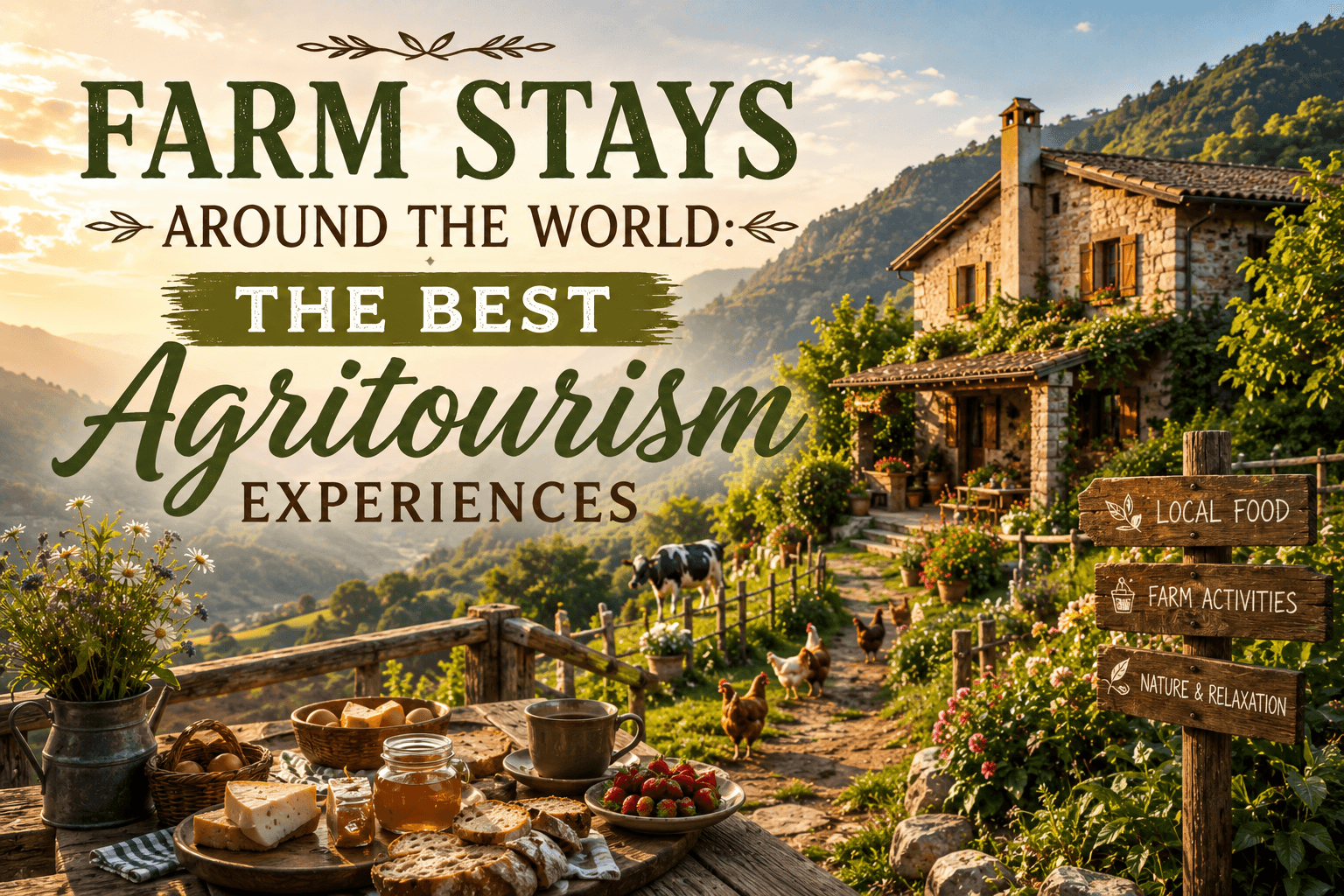
Farm Stays Around the World To Get The Best Agritourism Experiences
Sahil 30 May 2026Nature and Wildlife
It was 6am on a farm outside Siena, and I was completely, embarrassingly wrong about something I had believed my entire life. I had believed that the tomato at the grocery store, the one I had been buying for thirty years and putting in salads and cooking into sauces, was the same tomato as the one I had just bitten into in this Tuscan vegetable garden. Still warm from the night's retained heat. Picked twenty seconds ago. Tasting of sun and soil and something sweet-acid that I could not name because I had never encountered it before.
It was not the same tomato. It was not even close to the same tomato. It was categorically a different experience of what a tomato was, and the fact that both the grocery store version and this one had the same name suddenly seemed like a significant failure of language. Farm stays do this. They take things you thought you understood and reveal the gap between the version you knew and the original. The best farm stays are typically small, family-run properties that offer guests a chance to experience country life through meaningful activities like harvesting, animal care, and farm-to-table meals. But the reason they matter in 2026 is larger than any single activity they offer. In this day and age, travellers are increasingly more interested in where their food is grown and connecting with the land that provides it. Perhaps this reflects a need to unplug and enjoy a simpler way of life, but farm stays are globally on the rise.
Expedia's Unpack 26 report flagged agritourism as one of the highest-growth travel categories of the year, with farm stay reviews on Vrbo up 300 percent year-over-year. This guide covers the destinations doing it best, what to expect, and why the experience is worth considerably more than the cost of any flight to get there.
What Agritourism Actually Means and Why It Has Changed
Agritourism is the practice of visiting a working farm, ranch, vineyard, or orchard as a tourist, typically staying on the property and engaging directly with whatever the land produces. The concept is ancient. The execution in 2026 has evolved considerably. Traditional farm stays are evolving into something more sophisticated than a simple rural escape. The best operations now combine genuine agricultural education with the kind of food, accommodation, and programme quality that competing with a boutique hotel requires. A Tuscan agriturismo that serves three-course dinners from the kitchen garden, offers morning cheese-making workshops, and has a wine cellar stocked with its own production is not a compromise on comfort. It is a different and often superior kind of hospitality rooted in something the hotel industry cannot manufacture: a real relationship between a property and its land.
Urban vertical farms, rooftop gardens, and controlled environment agriculture facilities are becoming destinations themselves, offering educational tours and farm-to-table experiences within city limits, creating a spectrum from fully urban to deeply rural that means agritourism is no longer exclusively about escaping the city. But the most transformative experiences remain the ones where the land is genuinely working, the food genuinely comes from the ground within walking distance of where you eat it, and the people hosting you have a multi-generational relationship with the property that informs everything they cook and teach.
Best Farm Stay Destinations Around the World
Tuscany, Italy: The Gold Standard of Agritourism
Best for: Families, couples, wine lovers, food travellers
Best time to visit: April to June and September to October
Starting price: From $104 per night; luxury from $350 per night
Italy invented the word agriturismo and Tuscany is where the concept reaches its highest expression. Agritourism, also known as agriturismo, is a form of tourism centred around agriculture. Sights, smells, and savours come together to take you on a fully embodied experience across the fields of Italy, always placing nature and agriculture at the centre of your pleasure. Tuscany is perhaps the richest region of Italy for agritourism.
The Tuscan agriturismo is a specific institution with specific qualities. It typically occupies a farmhouse of several centuries of age, surrounded by its own vineyards, olive groves, and kitchen garden. Breakfast uses the farm's own eggs, honey, and cured meats. Dinner is cooked from what was harvested that morning. The wine comes from vines visible from your bedroom window. Il Segreto di Pietrafitta is an atmospheric 15th-century farmhouse just outside San Gimignano. It is a thoroughly charming place with a stunning hillside location, excellent food, and beautiful accommodation. The rooms feature classic Tuscan wood-beamed ceilings, terracotta floors, sturdy hand-crafted furniture, and colourfully tiled old-style bathrooms. Possibly Tuscany's most highly rated agriturismo by consistent guest testimony.
For the luxury end, Villa Lena estate is located in the Province of Pisa, secluded amongst 500 hectares of woodland, vineyards, olive groves, and organic vegetable gardens. A 19th-century villa sits at the heart of the property, originally built for an Italian aristocratic family. It now houses the Villa Lena Foundation and artist-in-residence programme. The Osteria serves farm-to-table meals from the organic kitchen garden and the surrounding estate. It is simultaneously an agricultural operation and one of the most thoughtful slow-living retreats in Europe. The harvests are the calendar-specific experiences worth planning around. Olive picking in November is the most tactile, with nets spread under the trees and the mechanical rhythm of hand harvesting creating a specific physical satisfaction. The grape harvest in September produces the most social atmosphere, when multiple families and guests work the same rows together.
What surprised me most about Tuscany farm stays was not the food quality, which I expected to be excellent. It was the slowing down of time. Three days on a working farm in the Val d'Orcia passes at a different rate from three days in Florence. Both are extraordinary. Only one of them sends you home genuinely rested.
New Zealand: Farm Stays on the Edge of the World
Best for: Adventure travellers, families, nature enthusiasts
Best time to visit: October to April (Southern Hemisphere summer)
Starting price: From NZD $150 per night
New Zealand has one of the oldest and most developed farmstay traditions in the world, built on a sheep and cattle farming culture that has been hosting travellers since long before the concept had a name. The scale here is what strikes you first. A New Zealand high-country station can cover 20,000 hectares of South Island landscape, with snowcapped peaks visible from the farmhouse window and the nearest town hours away by unsealed road. The working farm experience in New Zealand involves mustering sheep with dogs on horseback, feeding merino lambs in winter, helping with shearing, and watching boundary riders manage land at an altitude and scale that makes Tuscan vineyards look like garden plots. The physical engagement is real because the farms are genuinely operating and the activities are genuinely necessary.
The Wanaka and Queenstown regions of the South Island have the most developed farmstay networks alongside the most dramatic landscape context. Staying on a high-country station above Lake Wanaka, with the Southern Alps as a permanent backdrop and the specific silence of a landscape with no human infrastructure for twenty kilometres in every direction, produces a quality of disconnection from ordinary life that is genuinely difficult to achieve elsewhere. Farmstay New Zealand, the industry organisation, coordinates a network of registered properties across both islands with verified standards for accommodation and experience quality. Booking directly through their network rather than third-party aggregators typically provides better rates and more honest descriptions of what to expect.
The one thing most visitors miss: The night sky on a New Zealand high-country farm is among the finest available in the Southern Hemisphere, sitting at Class 1 to 2 on the Bortle scale when cloud cover allows. The stars from a farmhouse veranda in the Mackenzie Basin will change how you think about what a night sky looks like.
Japan: Satoyama and the Art of Countryside Living
Best for: Cultural immersion, slow travel, couples, solo travellers
Best time to visit: April to May (cherry blossoms, spring planting) and September to November (harvest)
Starting price: From ¥8,000 ($55) per night at traditional farmhouses
Japan's satoyama farmstay tradition occupies a completely different cultural category from the European or Antipodean equivalents. The satoyama concept refers to the specific landscape of mountain villages and the agricultural communities that have maintained them for centuries. Staying in a traditional Japanese farmhouse, a minka with thatched roof and earthen floor, in a village of thirty households in the mountains of Gifu or Nagano, is one of the most complete cultural immersions available in modern travel. The activities at Japanese agritourism properties centre on seasonal agricultural work: rice planting in May and June, harvesting in September, mushroom cultivation in the forest margins, silk cocoon unwinding at the mulberry farms of the Suwa basin, and the specific art of soba buckwheat noodle making from locally grown grain. Each one is a different quality of sensory and cultural education.
The Iya Valley in Tokushima Prefecture and the Shirakawa-go region of Gifu, both UNESCO Heritage sites, have the most developed agritourism infrastructure while retaining genuine agricultural character. The farmhouses here have been converted with care for authentic atmosphere, and the evening meals served at the irori (central hearth) are among the finest examples of Japanese mountain cuisine available outside specialist restaurants. One mistake many travellers make with Japanese farmstays is booking too briefly. A single night gives you arrival and departure. Two nights gives you a morning. Three nights is where the cultural context, the specific rhythm of the village, and the relationship with the family hosting you begin to become real.
Language: Most rural Japanese agritourism properties have limited English. Booking through JNTO-listed operators or through the Satoyama Experience in Gifu, which specifically serves international visitors, resolves this practically without removing the authentic character.
Rajasthan, India: Camel Farms and Desert Agriculture
Best for: Cultural immersion, adventure travellers, photographers, families
Best time to visit: October to February
Starting price: From INR 3,500 ($42) per night
India's agritourism is as diverse as the country itself, but Rajasthan has developed a farm and rural tourism offer that is specific enough to warrant its own category. The desert state combines traditional camel breeding, organic spice cultivation, millet farming on red sand soil, and the specific hospitality traditions of the Rajasthani community in a way that produces a genuinely immersive cultural experience. The Bishnoi villages outside Jodhpur are the most distinctive agritourism environment in the state. The Bishnoi community's centuries-old ecological philosophy, which prohibits harming any living thing and particularly trees and animals, has created landscapes of extraordinary biodiversity within the desert. The blackbuck antelope and chinkaras (Indian gazelles) that graze alongside the village fields are wild animals that have lived in this community for so long that the concept of wildness barely applies. Farm visits here feel more like meeting neighbours than wildlife watching.
The camel breeding farms of Bikaner are a different category of experience, where the Raika community have managed Bactrian and dromedary camels for centuries and still live in a social relationship with their animals that has no equivalent in modern animal husbandry. Morning tea with a Raika camel herder watching his herd move through the pre-dawn desert is one of those simple, specific experiences that functions as the entire justification for travelling. Organic spice farm stays in the Kota and Baran districts combine accommodation in traditional haveli farmhouses with hands-on coriander, fenugreek, and ajwain cultivation and harvesting.
Grenada, Caribbean: Spice Farms and Cocoa Plantations
Best for: Food lovers, Caribbean travellers, luxury agritourism
Best time to visit: February to June (dry season)
Starting price: From $90 per night; Belmont Estate from $180 per night
Grenada is expanding as a tourist destination, but it is also a shelter for agriculture. From spice farms to cocoa plantations up to this tiny isle nation that boasts a wealth of agritourism appeal. Cinnamon, cloves, mace, nutmeg, and turmeric are growing here in higher quantities than anywhere in the world. The specific Grenada agritourism experience is rooted in something that exists nowhere else at the same density: the overlap of a tropical spice economy with a tourist economy small enough that the farms are still primarily agricultural operations rather than performance venues for visitors.
Belmont Estate is one of the Caribbean's top agritourism resorts. This three-century-old property has a thriving cocoa business and nutmeg operation. Belmont features an organic ranch and a restaurant that operates serving customary Grenadian food formed from ingredients growing on the site. The cocoa fermentation and drying processes are open to guests, and the chocolate production that follows, from bean to bar in a facility that guests can watch and participate in, is one of the finest farm-to-finished-product experiences available in the Caribbean. The nutmeg processing cooperatives, where the specific aroma of Grenadian nutmeg fills the air from the drying racks visible at the roadside across the interior, are open for visits and the combination of the production process explanation, the tasting, and the purchasing directly from the source produces one of the most satisfying food souvenir experiences available anywhere.
What most visitors do not know: Grenada was the world's second-largest nutmeg producer before Hurricane Ivan in 2004 destroyed the industry. The island's complete reconstruction of its spice economy since then is a story of genuine agricultural resilience that makes the product taste different when you understand what it took to grow it.
Australia: Outback Stations and Wine Country Farms
Best for: Adventure travellers, wine lovers, families wanting a truly vast landscape
Best time to visit: April to October (cooler months)
Starting price: From AUD $120 per night; wine estate properties from AUD $250
Australia's farm stay landscape spans two completely different scales. The outback cattle station, potentially covering a million acres of red earth with a cattle herd of 50,000 animals, is an agricultural operation of incomprehensible size where guest participation in the mustering, branding, and stock management genuinely contributes to the running of the property. This is not theatrical farming. This is real work. The wine country farm stays of the Barossa Valley, Clare Valley, and Margaret River region are the other category: properties where the agricultural product is wine, the accommodation is often extraordinary, and the relationship between guest and land is mediated primarily through tasting rooms and cellar door dinners rather than physical labour.
Collingrove Homestead in the Barossa Valley, a heritage-listed 1856 property on a working estate, combines the wine country experience with genuine historic architecture and the specific feeling of staying in a property that has been continuously occupied and managed for 170 years. The cellar door access for guests and the surrounding Barossa landscape of mature vineyards and gum trees make it one of Australia's most complete agritourism properties.
For the outback station experience, Undara Experience in Queensland puts you in converted railway sleeping cars on a cattle station surrounding the world's longest intact lava tube system. The combination of genuine outback agricultural operation, extraordinary geology, and the specific atmosphere of a landscape that makes everywhere else on earth look recently built is one of Australia's most unusual and most rewarding travel experiences.
Sri Lanka: Tea Estate Stays in the Hill Country
Best for: Tea lovers, slow travellers, photographers, those wanting colonial architecture alongside agriculture
Best time to visit: January to March and July to August
Starting price: From $80 per night; luxury bungalows from $250 per night
Sri Lanka's hill country tea estate stays are one of the most visually and sensorially distinctive farm stay experiences available in Asia. The combination of the specific green of tea cultivation on steep hillside terraces, the cool misty air of the Nuwara Eliya region, the colonial planter bungalows that have been converted into guest accommodation, and the extraordinary quality of the tea produced within walking distance of where you sleep creates an experience that is entirely specific to this landscape. The best tea estate stays offer a complete day in the life of tea: walking the plucking rows with the pickers in the morning, visiting the processing factory where withering, rolling, oxidation, and drying transform the fresh leaf into the finished product, and tasting the estate's production across different grades and processing methods in the late afternoon.
The Dilmah estates in the Nuwara Eliya region are the most internationally accessible, with accommodation and experience packages that can be booked well in advance. For a more intimate experience, the smaller single-bungalow estates in the Haputale and Ella areas rent entire colonial-era plantation manager's bungalows to single parties, providing a level of privacy and immersion that the larger properties cannot offer.
Farm Stay Experiences Worth Travelling For
The activities available at the world's best farm stays have evolved significantly beyond simply watching animals being fed. Cheese-making workshops in Vermont and Tuscany produce results you carry home in your bag. Lavender harvesting in Provence in June, where the specific combination of the colour and the smell and the sound of bees creates the most complete sensory environment available in summer France, is a farm activity that exceeds the photographs on every level. Coffee farm tours in Colombia and Ethiopia, where the journey from ripe red cherry on the branch to the cup you drink at the end takes a complete day and involves a dozen distinct processes, produce the kind of understanding of a product that transforms how you consume it permanently.
Horse trekking on New Zealand stations, camel mustering in Rajasthan, and fishing on Irish sea farms all provide direct engagement with the agricultural reality of their specific landscapes. These activities are not staged for tourists. They are the actual work of the farm, and your participation is genuine rather than theatrical.
What to Look For When Booking a Farm Stay
The single most important factor in a farm stay's quality is whether the property is a genuinely working farm or a hospitality business that has adopted farm aesthetics. A genuinely working farm has animals whose purpose is production, not entertainment. It has a seasonal calendar that determines what activities are available and when. The food at the table comes from the property and changes with what is growing. The family hosting you has a relationship with the land that predates the tourism operation.
The hospitality-first properties with farm elements have pleasant surroundings and good food but the agricultural work is incidental to the guest experience rather than central to it. Both can be excellent. Only one delivers the specific transformation of understanding that makes agritourism genuinely different from other forms of travel. The most memorable stays combine comfortable accommodation with sustainable farming practices and authentic, local hospitality. Read reviews that specifically mention learning something, being surprised by something, or understanding a food differently after the visit. These markers indicate that the farm stay delivered what the category is supposed to provide.
Budget Guide: What Farm Stays Cost Around the World
Destination | Budget Per Night | Mid-Range | Luxury | Includes |
|---|---|---|---|---|
Tuscany, Italy | $104 to $180 | $180 to $350 | $350 to $800 | Breakfast; some include dinner |
New Zealand | NZD $150 to $250 | NZD $250 to $400 | NZD $400 to $700 | Breakfast, farm activities |
Japan | $55 to $120 | $120 to $250 | $250 to $500 | Dinner and breakfast typically |
Rajasthan, India | $42 to $100 | $100 to $200 | $200 to $500 | Meals, farm activities |
Grenada | $90 to $150 | $150 to $300 | $300 to $600 | Meals, farm tour |
Australia (Wine Country) | AUD $120 to $250 | AUD $250 to $450 | AUD $450 to $900 | Breakfast, cellar door access |
Sri Lanka (Tea Estates) | $80 to $150 | $150 to $300 | $250 to $600 | Full board often included |
Expert Tips for Getting the Most From a Farm Stay
Book for minimum three nights. One night gives you arrival and departure. Three nights gives you enough time to settle into the rhythm of the property, to be trusted with more genuine agricultural tasks on day two, and to develop the kind of familiarity with the place that produces the conversations and moments that make a farm stay memorable.
Travel in shoulder season. The harvest seasons, olive picking in October and November in the Mediterranean, grape harvest in September, tea plucking peaks in Sri Lanka between January and March, are the times when farm stays are at their most genuinely active. They are also when booking competition is highest. The quieter seasons have their own agricultural rhythms and significantly lower prices.
Ask specifically about the activities you want. A cheese-making workshop is available on request at many Italian agriturismi but not listed as a standard activity. The olive oil pressing is a seasonal event that requires scheduling. The bread baking happens on specific mornings. Most farm stay hosts will accommodate specific requests if given advance notice, and the result is a personalised experience that the general daily programme cannot provide.
Bring clothes you are willing to ruin. The agricultural work available at genuine farm stays involves mud, animal contact, juice from harvested fruit, and the specific stains of actual soil. The guests who get the most from a farm stay are the ones who arrived prepared to participate rather than observe.
Eat everything you are offered. The food at a working farm uses whatever is at its peak on that specific day. The dish you have never heard of, made from the vegetable you do not recognise from the garden, is almost always the best thing at the table. Ask what it is after you have decided you like it.
Mistakes to Avoid When Booking a Farm Stay
Choosing based on Instagram content rather than agricultural authenticity. The most photogenic farm stays are not necessarily the most genuinely agricultural ones. A beautiful infinity pool in a vineyard landscape is a lovely hotel. A farmhouse where the owner's family has been making the same wine for four generations is an agritourism experience. Read the property description for evidence of actual farming rather than farming aesthetics.
Underestimating early mornings. The agricultural activities that are most worthwhile, the dawn milking, the morning market run, the early harvest work before the heat builds, happen before most people are comfortable waking. Committing to the early schedule on at least one morning of a farm stay is the difference between a pleasant rural break and a genuinely educational experience.
Not confirming seasonal activity availability before booking. A Tuscan olive farm in July has no olives on the trees. A tea estate in a dry season gap may not be doing active processing. The specific activities you are interested in are often seasonal and sometimes unpredictable. Confirm availability directly with the property before booking if a specific activity is the primary reason for your visit.
FAQ: Farm Stays and Agritourism Around the World
What is agritourism and what does a farm stay involve?
Agritourism, also known as agriturismo in Italy, is the practice of staying on a working farm, vineyard, ranch, or agricultural property as a traveller, engaging directly with the land and its production. A farm stay typically involves accommodation on the property, meals produced from or featuring the farm's own ingredients, and hands-on activities including harvesting, animal care, food production workshops, and guided farm walks. The best farm stays combine genuine agricultural education with comfortable accommodation and exceptional farm-to-table food.
Which country has the best farm stays in the world?
Italy, particularly Tuscany, is considered the gold standard for farm stay agritourism due to its highly developed agriturismo tradition, extraordinary food culture, beautiful landscape, and the depth of its food and wine production heritage. New Zealand leads for landscape scale and genuine working farm participation. Japan's satoyama farmstay tradition offers the deepest cultural immersion. The best choice depends entirely on whether food, landscape, culture, or hands-on activity is the primary motivation.
What is the best time of year to visit a farm for agritourism?
Harvest seasons provide the most active and participatory farm stay experiences. In Tuscany, the grape harvest runs from mid-September to mid-October and olive harvesting from October to November. New Zealand's lambing season from August to October is the most visually engaging period. Sri Lanka's tea flush peaks from January to March and July to August. In Rajasthan, the winter months from October to February offer the most comfortable temperatures for agricultural tourism activities.
How much does a farm stay cost?
Costs vary significantly by destination and quality level. Budget farm stays in India and Sri Lanka start from $42 to $80 per night, typically including meals. Mid-range agriturismi in Tuscany run $150 to $350 per night with breakfast and often dinner included. New Zealand high-country station stays average NZD $150 to $400 per night with included activities and meals. Luxury farm stays at properties like Villa Lena in Tuscany or Belmont Estate in Grenada run $300 to $800 per night with comprehensive programmes.
Are farm stays suitable for families with children?
Yes, farm stays are consistently rated among the most child-appropriate travel experiences available. Children engage naturally with animals, enjoy harvesting activities, and benefit enormously from understanding where food comes from. Italian agriturismi are specifically well-suited to families, with many offering babysitting, children's programming, and facilities designed for family stays. New Zealand station stays provide the space and outdoor freedom that children thrive in. Japan's farmstay tradition is culturally welcoming to families and the agricultural activities are generally accessible to older children.
What should I pack for a farm stay?
Pack comfortable clothes that you are happy getting dirty, sturdy closed-toe shoes or boots for outdoor work, and layers for early morning and evening temperature drops. A rain jacket is essential at most farm destinations. Bring a reusable bag for shopping at farm stalls or markets. Most farm stays have limited mobile signal, so downloading offline maps, translation apps, and entertainment in advance is practical. Leave excessive luggage at a city hotel if your farm stay is part of a longer itinerary, as luggage management on working farms is often less convenient than at hotels.
How do I find an authentic farm stay rather than a farm-themed hotel?
Look for properties that describe specific seasonal activities tied to what the farm actually produces. A genuine working farm lists activities that change by season because the farming calendar changes. Read reviews that mention learning something specific, being surprised by the reality of farm work, or tasting food that changed how the reviewer understood an ingredient. Properties that describe a "farm experience" without specifying what that means are typically offering hospitality with rural aesthetics rather than genuine agricultural immersion. Booking through specialist networks like Farmstay Planet, the official New Zealand Farmstay network, and direct contact with Italian agriturismo associations produces better results than generic travel aggregators.
The Final Word
I keep thinking about that tomato in Tuscany.
Not because tomatoes are particularly interesting as a philosophical subject, but because the gap between what I had eaten my whole life and what I ate that morning in the garden was so large that it implied something beyond the tomato itself. It implied that there were similar gaps in my understanding of most things I consumed. That the version of reality available at the source, before the distribution chain and the refrigeration and the standardisation, was consistently richer, more specific, and more genuinely itself than anything I had been offered as a substitute.
Whether it is experiencing life on a working farm or ranch, mingling with animals, or assisting with a wine harvest, agritourism is the chance to escape your daily routine and immerse yourself in the world of a local farming experience.
The best farm stays around the world offer that immersion. In the Tuscan kitchen garden, the New Zealand station at dusk when the dogs are put away and the mountains go pink, the Japanese farmhouse around the irori fire, the Grenadan cocoa house where the fermentation smell mixes with the sea air.
These are places where the ordinary transactions of daily life, eating, working, resting, being fed by people who grew the food, become genuinely extraordinary. Not because they have been designed to feel that way, but because they are what they are: land that has been tended with care for a long time, by people who know exactly what it can produce, and who are willing to show you.
Go find your version of that tomato.
All pricing is approximate and based on 2026 data. Farm stay seasonal activity availability varies and should be confirmed directly with properties before booking. Harvest dates depend on annual weather patterns and may vary from year to year.