Top 10 Places to Visit in Australia
Arthur Bennett 27 May 2026Travel
Australia broke my sense of scale completely the first time I visited. I had been warned about the distances. People told me it is big. What they did not tell me is that big means something different in Australia than it does anywhere else. In Europe, a three-hour drive crosses multiple countries and cultures. In Australia, a three-hour drive might get you to the next town of any size, and the landscape outside the window for most of that drive will be so consistently vast and ancient-looking that your brain starts doing something unusual: it stops expecting things to change and starts simply accepting the scale as a fact of the country's existence.
Then you arrive somewhere. The Great Barrier Reef materialises below you when you put on a mask for the first time. Uluru appears on the horizon three hours before you reach it, already the right shade of deep red-orange, impossibly large, sitting in the flat red landscape as if it has been waiting specifically for you. The Sydney Opera House appears as your ferry approaches Circular Quay and suddenly every photograph you have ever seen of it makes complete sense because the building is doing something with the light that photographs can suggest but not contain.
Australia's iconic landmarks and natural wonders continue to top bucket lists, with Sydney and Melbourne leading arrivals while the Great Barrier Reef and Uluru remain must-see draws for their unique appeal. Tourism Research Australia data shows international arrivals reaching around 8.8 million in late 2025 with strong growth projected for 2026.
This guide covers the ten places worth building an Australia trip around. Not just the most famous, though most of the famous ones are here because they earned it. The specific detail, the honest assessments, and the things you only learn from actually going.
1. Sydney: The City That Earns Every Superlative
Best time to visit: September to November (spring) or March to May (autumn)
How long to allow: Minimum 4 to 5 days
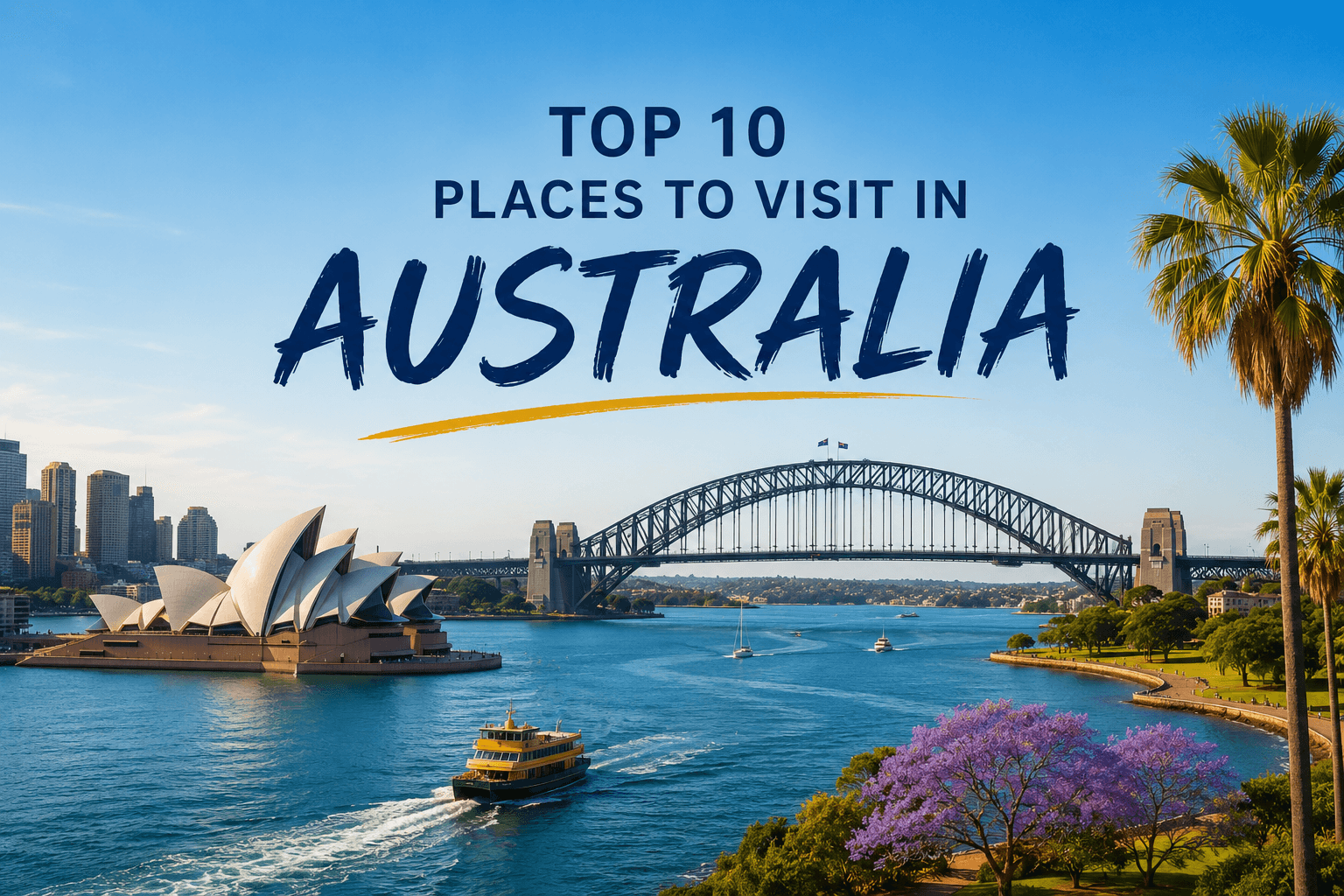
Sydney tops nearly every list as Australia's most visited destination. Visitors flock to the Sydney Opera House, a UNESCO World Heritage site whose sail-like design gleams against the water, and the Harbour Bridge, where bridge climbs offer panoramic views. Bondi Beach draws sun-seekers and surfers year-round, while nearby Manly and Coogee provide more relaxed coastal escapes. Sydney is where most international travellers begin and where the experience of Australia's specific combination of urban sophistication and natural setting first becomes comprehensible. The harbour is genuinely one of the most beautiful urban water settings in the world, and the Opera House and Harbour Bridge together create a skyline that functions in real life with the same resonance it carries in photographs.
The Opera House deserves more than a walk-past and a photograph. Take a guided architectural tour of the interior, which reveals the specific complexity of Jorn Utzon's design, the acoustic engineering decisions, and the way the building reads differently from every angle and in every light. The tour costs approximately $45 AUD and runs 90 minutes. The pre-performance tour, which includes entry to a performance, is the specific upgrade that turns a sightseeing experience into something with genuine cultural depth. The Harbour Bridge climb costs $148 to $373 AUD depending on time of day and variant, and delivers one of the finest urban views on earth. The 134-metre summit provides a 360-degree perspective of the harbour, the city, the Blue Mountains visible on the western horizon, and the specific geometry of how Sydney's suburbs spread across the sandstone headlands that frame the water. The experience, which takes two and a half hours in total, is the right level of physical effort to make the view feel earned.
Stroll the historic Rocks district with its cobblestone lanes and street markets. In 2026, the recently completed Sydney Fish Market upgrade enhances the waterfront dining scene with fresh seafood and vibrant eateries. Sydney's multicultural food scene shines in neighbourhoods like Chinatown and Newtown, while the nearby Blue Mountains provide day trips for hiking amid eucalyptus forests and the famous Three Sisters rock formation. The Blue Mountains are three times as good a day trip as most visitors expect. The Three Sisters viewpoint at Echo Point is the famous image, but the walking trails below it into the Jamison Valley, where the forest floor of a blue gum woodland is genuinely different from any other forest in the world, are where the visit becomes an experience rather than a viewpoint tick.
The Bondi to Coogee coastal walk is the single best free activity in Sydney. The six-kilometre path follows sandstone headlands above the Pacific, passing four beaches, ocean pools carved into the rock, and viewpoints where the specific quality of Sydney's coastal light, sharp, bright, slightly orange-tinted, is on full display. Allow three hours and take the whole walk.
Where most visitors go wrong: Spending all five days in the city centre. Manly, accessible by ferry from Circular Quay (the ride itself is extraordinary), and the Royal National Park south of the city deserve at least a day each.
2. The Great Barrier Reef: The Living Wonder
Best time to visit: June to October (dry season, no marine stingers)
Base town: Cairns or Port Douglas
How long to allow: 2 to 3 days minimum
The Great Barrier Reef is the planet's largest coral reef system, a UNESCO World Heritage site stretching over 2,300 kilometres. From Cairns or Port Douglas, hop on a boat to outer reef sites for encounters with colourful corals, turtles, rays, and tropical fish. Port Douglas, highlighted in recent travel predictions, offers luxury spas alongside reef access and Daintree Rainforest proximity. Climate-aware operators now prioritise low-impact experiences, making 2026 an ideal time to witness this wonder responsibly. The Great Barrier Reef is the world's largest living structure and the correct response to seeing it for the first time underwater is to float completely still and try to process the fact that this is real.
The experience of being inside the reef, with coral formations in colours that seem digitally enhanced (they are not), with sea turtles moving through the water with the specific unhurried confidence of something that has been doing this for a hundred million years, and with the specific silence of being underwater where the only sounds are your own breathing and the distant creaking of coral, is one of those travel experiences that genuinely changes your sense of what the planet contains. Though everyone leaves from Cairns, leaving from Port Douglas will get you to less crowded spots. This is the specific operational tip that changes the quality of the experience significantly. Cairns-based tour boats are larger, faster, and carry more passengers. Port Douglas operators run smaller boats to outer reef sites that receive significantly less visitor traffic. The coral health and the wildlife encounter quality are both better for the extra thirty minutes of additional transit.
The outer reef versus inner reef distinction matters enormously. The inner reef, accessible on day trips from Cairns, has suffered more coral bleaching from elevated water temperatures and has lower visibility and less marine life density than the outer reef. Specifically book outer reef day trips. They cost slightly more and take slightly longer to reach. They are worth the difference absolutely.
Snorkelling versus diving: First-time visitors to the reef frequently agonise over this decision. Both are extraordinary. Snorkelling is free to try without certification, produces remarkable encounters within the top two metres of water, and requires no physical training. Scuba diving requires either an existing PADI open water certification or an introductory dive with an on-boat instructor. Introductory dives cost approximately $100 to $150 additional and provide access to the deeper coral structures and larger marine life that do not come to the surface. If time allows even a single introductory dive, take it.
The honest conservation note: The Great Barrier Reef has experienced repeated mass coral bleaching events driven by warming ocean temperatures. Significant sections of the reef have been affected. The reef is not dying but it is changing. Going in 2026, with reputable low-impact operators who prioritise reef health, is both a better experience and a contribution to the economic case for its protection.
3. Uluru-Kata Tjuta National Park: The Heart of Australia
Best time to visit: April to September (cooler months, under 30 degrees Celsius)
Base town: Yulara resort village
How long to allow: 2 nights minimum
In the heart of the Red Centre, Uluru stands as a sacred sandstone monolith, glowing red at sunrise and sunset. This spiritual site, managed by the Anangu people, offers deep cultural insights through guided walks sharing Dreamtime stories. Uluru is the most frequently photographed natural icon in Australia and the most frequently misunderstood. Most visitors arrive to see a rock. They leave having experienced something more like a place of genuine power, which is a phrase that sounds like brochure language until you have sat at the base of the monolith in the pre-dawn quiet waiting for the sun to appear over the horizon and watched the colour of the stone change through fifteen different shades of red-orange and purple in the space of forty minutes.
The Anangu people, the Traditional Owners, have managed this site for tens of thousands of years. Since October 2019, climbing Uluru has been permanently closed at the request of the Anangu, who consider it deeply disrespectful to climb their sacred site. The closure has improved the experience of visiting significantly because it has redirected visitor attention to the genuinely interesting ways of engaging with the monolith: the base walk, the dot painting workshops, the ranger-guided cultural tours, and the Field of Light installation at dawn. The 10.6-kilometre base walk around the full circumference of Uluru takes three to four hours and reveals the changing character of the rock at ground level in a way that no viewpoint from a distance can communicate. The rock surface contains dozens of specific sites, waterholes, caves, and formations with specific Anangu cultural significance. The guided cultural walks explain this context and transform the walk from a circumnavigation into a reading of an ancient landscape.
Kata Tjuta, the domed rock formation 50 kilometres from Uluru, is the genuinely underappreciated half of the park. The Valley of the Winds walk, which penetrates deep into the gorges between the domes of Kata Tjuta, is more physically demanding and more visually dramatic than anything available at Uluru itself.
The stargazing: The Red Centre has zero light pollution. The Milky Way visible from outside Yulara on a clear night is among the finest available anywhere in Australia. The Ayers Rock Resort offers guided stargazing sessions. Going independently with a blanket on the ground outside any lit area is equally effective and free.
4. Melbourne: Culture, Coffee, and the World's Most Liveable City
Best time to visit: October to April (summer season)
How long to allow: 4 to 5 days
Melbourne is known for its culture, street art, coffee culture, and music festivals. Melbourne and Sydney have a rivalry that Australians treat with more seriousness than it deserves from the outside, but the rivalry exists because the two cities are genuinely different in character and both are genuinely extraordinary. Sydney has the harbour. Melbourne has the laneways. The hidden lanes of the CBD, Hosier Lane with its constantly evolving street art, Degraves Street with its espresso bars built from the 1870s Victorian buildings that line both sides, AC/DC Lane because the city is specifically that kind of place, create a pedestrian city experience that Sydney's broader, more open streets do not replicate.
Melbourne's coffee culture is the most serious in Australia, which means it is among the most serious in the world. The third-wave specialty coffee scene here is built on a competitive quality standard that produces consistently excellent results at independent cafes across the city. Ordering a flat white in Melbourne and receiving a mediocre one is genuinely rare. Ordering one in most other cities and receiving an excellent one is considerably less guaranteed. The Melbourne laneways, the Melbourne Cricket Ground (MCG) tour, the Royal Botanic Gardens, and the street art trail around Fitzroy and Collingwood are free or very low cost. The restaurant scene in Flinders Lane and the neighbourhoods of Brunswick, Fitzroy, and Northcote is where the genuinely exciting dining is concentrated and reflects the city's immigrant diversity in specific and compelling ways.
The specific things to do:
Coffee at Market Lane Coffee (multiple locations)
Breakfast in Fitzroy (Proud Mary, Touchwood, Hardware Société are the benchmarks)
St Kilda Beach and the Acland Street cake shops
Queen Victoria Market (Tuesday, Thursday to Sunday)
National Gallery of Victoria (NGV) on St Kilda Road (free for Australian collections)
5. The Great Ocean Road: The Drive That Defines Australian Coastal Beauty
Best time: September to April
Length: 243 kilometres from Torquay to Allansford
How long to allow: 2 to 3 days for the full drive
The Great Ocean Road remains one of Australia's most iconic scenic drives for its combination of coastal cliffs, rainforest, and the famous Twelve Apostles limestone formations. The Great Ocean Road was built by returned soldiers after World War One as a memorial to those who did not return and is dedicated to them. That context, the knowledge that this extraordinary road was created by hands that had survived something terrible to do something beautiful, adds a layer of significance to a drive that is already one of the most spectacular in the world. The Twelve Apostles are the most famous sight on the road but the number is misleading and always has been. There were never twelve distinct stacks; the name was a marketing decision in the 1950s. Currently eight stacks remain after ongoing erosion. The viewing platforms at both ends of the viewing area are extraordinary at sunrise and sunset when the orange limestone stacks cast shadows and glow against the Southern Ocean in ways that photographs genuinely struggle to capture.
Loch Ard Gorge, two kilometres west of the Twelve Apostles, is less photographed and more dramatic in person. The narrow canyon entrance, the peacock-blue water, and the story of the shipwreck that named it combine into a stop that most visitors spend more time at than the Apostles themselves. The Otway Ranges section of the drive, where the road passes through temperate rainforest with tree ferns of extraordinary age and height, is the counterpoint to the coastal drama. The Otway Fly Treetop Walk rises to 25 metres above the forest floor and costs $26 AUD. The view of the canopy from above, understanding for the first time how much sky a mature forest captures, is one of those experiences where the entrance fee seems insufficient.
6. Whitsunday Islands: Sailing in the Coral Sea
Best time to visit: June to October
Base: Airlie Beach
How long to allow: 3 to 5 days for a sailing experience
The Whitsunday Islands, including Whitehaven Beach with its swirling silica sands, provide idyllic sailing and island-hopping options. Whitehaven Beach on Whitsunday Island is consistently ranked among the world's finest beaches and the specific quality of its silica sand, pure white, so fine it squeaks when you walk on it, so cool it remains comfortable at midday even in summer, is genuinely unprecedented in the beaches I have been to.
The sailing experience in the Whitsundays is the specific thing to plan around. Bare-boat charter (hiring a yacht without a skipper, requiring basic sailing certification) starts from approximately $800 AUD per day for a three-to-four berth vessel. Crewed tour boats run two-day overnight experiences from $350 to $500 AUD per person. Budget backpacker sailing tours start from $250 AUD for a two-day trip. The Hill Inlet lookout at the northern tip of Whitsunday Island is where the famous swirling pattern of tidal sand and turquoise water that appears in every photograph of Whitehaven Beach is visible from above. The 30-minute walk to the lookout is the only access and the view is one of the most extraordinary coastal landscapes in Australia.
7. Tasmania: The Wild Island at the Bottom of the World
Best time: December to March (summer, ideal for hiking)
Entry point: Hobart (flights from mainland cities)
How long to allow: 7 to 10 days to cover the main highlights
Tasmania is the destination that Australians who have been there rate most highly and that most international visitors allocate too little time for. Tasmania's Freycinet National Park is one of the most attractive places in Australia that many visitors overlook. The island covers 68,000 square kilometres, approximately the size of Ireland, with 47 percent of its land area protected as national parks, reserves, or World Heritage wilderness. The Cradle Mountain-Lake St Clair National Park in the centre, the Freycinet Peninsula on the east coast, the Tarkine wilderness in the northwest, and the Bay of Fires on the northeast coast are all genuinely extraordinary landscapes that feel meaningfully different from anything on the Australian mainland.
The Overland Track, a 65-kilometre multi-day hike through Cradle Mountain-Lake St Clair National Park, is widely considered one of Australia's finest wilderness walks. It takes five to seven days to complete and requires advance booking of hut accommodation or camping permits from October to May. The booking fee covers the hut system and ranger presence. The walk itself passes through alpine moorland, ancient rainforest, and mountain landscapes of genuine drama. Hobart's MONA (Museum of Old and New Art) deserves its own mention. Housed in a multi-level underground structure built into a sandstone headland above the Derwent River, MONA is the most genuinely exciting museum in Australia and one of the most interesting in the world. The collection combines ancient artefacts with provocative contemporary art in a building that is itself a significant work of architecture. Entry costs $40 AUD for adults. The ferry from Hobart to MONA is part of the experience.
Bruny Island: A 30-minute ferry from the Huon Valley delivers you to an island with some of the finest cheese (Bruny Island Cheese), fresh oysters, and wildlife (little penguins, echidnas, and wallabies) in Tasmania. The Neck, a narrow isthmus connecting the island's two halves, is one of the finest wildlife viewing spots in southern Australia.
8. Daintree Rainforest and Cape Tribulation: Where Ancient Rainforest Meets the Reef
Best time: May to October (dry season)
Access: From Cairns or Port Douglas, 2 to 3 hours drive
How long to allow: 2 days
Port Douglas offers luxury spas alongside reef access and Daintree Rainforest proximity. The Daintree Rainforest is the oldest tropical rainforest on earth, approximately 180 million years old compared to the Amazon's 55 million. The specific fact of its age becomes tangible when you stand in it and look at the tree ferns, cycads, and palms that are virtually unchanged from their Cretaceous-era ancestors, and realise that this forest existed when dinosaurs were walking through it.
Cape Tribulation, where the rainforest meets the coral reef in a landscape found nowhere else on earth, is the specific destination at the northern end of the Daintree. The beach here, where tropical rainforest overhangs white coral sand, is one of the most surreal-looking coastlines in the country. Two World Heritage Areas meet at this single point: the Wet Tropics of Queensland and the Great Barrier Reef. The Daintree Discovery Centre provides the finest introduction to the rainforest ecosystem, with canopy towers and aerial walkways that lift you into the mid-canopy zone where most of the forest's biodiversity is concentrated. Entry costs $39 AUD.
9. Kangaroo Island, South Australia: Australia's Wildlife Haven
Best time: September to May
Access: Ferry from Cape Jervis (45 minutes) or flight from Adelaide
How long to allow: 3 to 4 days
Kangaroo Island is one of the smaller gems in Australia that many visitors overlook. Kangaroo Island is approximately 150 kilometres long, separated from the South Australian mainland by only 16 kilometres of water, and contains wildlife encounters that require no national park infrastructure, no guided tour booking, and sometimes no more effort than walking to the end of a beach. Seal Bay Conservation Park has Australian sea lions resting on its beach in numbers that require you to pick your way around them. The guided beach walk, which takes you among the sea lions as they sleep, play, and nurse pups, costs $31 AUD and is one of the finest wildlife experiences in South Australia.
The Remarkable Rocks, granite boulders sculpted by wind and ocean into shapes that look like the work of a distracted surrealist, are one of Australia's finest geological formations. They are free to visit and best photographed at sunrise or sunset when the orange granite glows. Flinders Chase National Park at the island's western end has its own population of koalas, echidnas, kangaroos, and wallabies. The koala population here is genuinely dense enough that spotting one without searching requires only moderate attention. After 2020's devastating fires, Kangaroo Island has made a strong recovery. Much of the wildlife is regenerating well and the landscape has the specific quality of post-fire regeneration, where young green growth through burnt trees creates a landscape that is simultaneously damaged-looking and alive.
10. Perth and the Southwest: Australia's Hidden Western Gem
Best time: September to November (wildflower season and spring)
Entry point: Perth International Airport
How long to allow: 7 to 10 days for Perth plus Margaret River plus Ningaloo
Perth and Adelaide provide quiet charm, excellent wine regions, and cultural experiences for those looking for a less crowded itinerary. Karijini National Park puts Kakadu and Litchfield to shame, and Coral Bay and the Ningaloo Reef are even better than Cairns or the Great Barrier Reef. Perth is the most isolated city of its size in the world and the isolation produces a specific quality of life that its residents are fiercely proud of. The Indian Ocean beaches in and around Perth, Cottesloe, Scarborough, and City Beach, are genuinely world-class and significantly less crowded than equivalent beaches in Sydney.
Margaret River: Two hours south of Perth, the Margaret River wine region produces Australia's finest Cabernet Sauvignon and some of its finest Chardonnay. The combination of deep red gravelly soil, maritime climate, and multi-generational viticulture has created a wine culture that is serious without being pretentious. Visiting Vasse Felix, Leeuwin Estate, or Cullen Wines for a cellar door tasting and lunch among the vines is one of Australia's most complete food and wine experiences.
Ningaloo Reef: Ningaloo Reef in Western Australia is challenging its famous eastern counterpart in the bucket-list stakes, thanks in large part to the gentle giants that call it home between March and August. The gentle giants are whale sharks, the largest fish in the ocean, which aggregate at Ningaloo between March and August in numbers that allow virtually guaranteed swimming encounters. The experience of snorkelling alongside an eight-metre whale shark is one of the genuinely staggering wildlife encounters available in Australia.
Ningaloo also offers coral reef snorkelling accessible directly from shore, unlike the Great Barrier Reef which requires boat access. Pulling on a mask at Turquoise Bay, walking into waist-deep water, and finding yourself immediately above healthy coral with turtles and rays is one of the finest free snorkelling experiences on earth.
Quick Reference: Australia's Top 10 at a Glance
Destination | Best For | Best Season | Days Needed | Entry Cost |
|---|---|---|---|---|
Sydney | Urban culture, harbour, coastal walks | Sept to Nov | 4 to 5 days | Harbour Bridge climb $148+ AUD |
Great Barrier Reef | Snorkelling, diving, marine life | June to Oct | 2 to 3 days | Day trip $150 to $300 AUD |
Uluru-Kata Tjuta | Cultural depth, outback, stargazing | April to Sept | 2 nights | Park fee $38 AUD 3 days |
Melbourne | Coffee, food, culture, laneways | Oct to April | 4 to 5 days | Mostly free |
Great Ocean Road | Scenic drive, coastal drama | Sept to April | 2 to 3 days | Free drive, attractions extra |
Whitsunday Islands | Sailing, beaches, coral sea | June to Oct | 3 to 5 days | Sailing from $250 AUD |
Tasmania | Wilderness, hiking, MONA | Dec to March | 7 to 10 days | Park passes $25 to $40 AUD |
Daintree Rainforest | Ancient forest, wildlife, reef | May to Oct | 2 days | Discovery Centre $39 AUD |
Kangaroo Island | Wildlife, seals, geology | Sept to May | 3 to 4 days | Park fees vary |
Perth and Ningaloo | Beaches, wine, whale sharks | Sept to Nov | 7 to 10 days | Whale shark tour $400 AUD |
Best Time to Visit Each Australian Destination
Sydney, Melbourne, and Great Ocean Road: Visit in spring or autumn (September to November, March to May) for mild, pleasant weather and fewer crowds. Great Barrier Reef, Whitsundays, and Cairns: Best between June and October when it is dry, sunny, and free of marine stingers. Uluru and the Red Centre: Cooler months from April to September are ideal for hiking and exploring. Darwin and Kakadu: The Dry season from May to September is the best time to see waterfalls and avoid heavy rain. Tasmania: December to March offers clear skies and perfect hiking weather.
The specific challenge of timing an Australia trip is that the continent spans 35 degrees of latitude, from tropical Queensland to subantarctic Macquarie Island, and the seasons in different regions do not align. Designing a trip that puts you in Queensland in June to October and in Melbourne and Tasmania in November to March makes climatic sense and sequences well geographically.
Getting Around Australia: The Logistics Reality
Australia's distances require specific planning that most first-time visitors underestimate.
Domestic flights: Australia has an excellent domestic aviation network, with Qantas, Virgin Australia, and Jetstar connecting major cities and regional hubs. Sydney to Melbourne is a 90-minute flight (approximately AUD $80 to $180 booked in advance). Sydney to Cairns is 3 hours (AUD $150 to $300). Perth to Sydney is 5 hours (AUD $200 to $400). Book domestic flights as early as possible for the best prices.
Driving: Road trips in Australia are extraordinary experiences for the right traveller. The Great Ocean Road, the Western Australian coastline, the Red Centre loop, and the entire east coast are all genuinely rewarding driving routes. Rental cars are widely available and reasonably priced (from $40 to $80 AUD per day for a small car). The distances between stops require planning: the drive from Cairns to Sydney is 28 hours of driving. Nobody sensible does this without flights between sections.
Rail: The Indian Pacific (Sydney to Perth) and The Ghan (Adelaide to Darwin) are two of the world's great train journeys and the specific experience of watching Australia's interior landscape change over 65 hours is genuinely worth the time investment for travellers with flexibility. The Ghan costs approximately AUD $1,200 to $2,500 per person depending on cabin and season.
Expert Tips for Visiting Australia
Book Great Barrier Reef tours at least two weeks in advance for peak season (June to October) outer reef operators who run small-group boats. These sell out. The large-capacity day boats have availability through peak season. The quality difference between the two is significant.
Apply for the Australian Electronic Travel Authority (ETA) before you fly. The ETA replaces the traditional visa for most eligible nationalities and costs AUD $20. It must be applied for before departure. Processing is usually immediate but airlines will not board you without it. Apply via the Australian ETA app or through the Australian Department of Home Affairs website.
Start in Sydney, end in Melbourne, or reverse. The classic Australian itinerary combines both cities with Cairns (reef) and Uluru in a triangular route that covers the country's four most significant experiences efficiently. Fly in one city, out the other, and cover the two natural wonders by domestic flight in between. This structure makes maximum use of limited time.
Buy a national park pass if you plan to visit multiple parks in the same state or territory. The Uluru-Kata Tjuta, Kakadu, and Tasmanian national parks all have their own entry fee structures and multi-day passes represent better value than single-visit fees for stays of two or more days.
Respect Indigenous cultural protocols. Australian Aboriginal culture is the oldest living culture on earth and the sites managed by Indigenous communities, specifically Uluru, have specific protocols about photography, behaviour, and areas of access. These are not bureaucratic rules. They are the boundaries of sacred and significant places communicated respectfully. Engage with them as such and the experience is significantly richer.
Carry sunscreen at all times. The Australian sun, combined with ozone layer thinning over the southern hemisphere, is genuinely more intense than most visitors from temperate climates experience at home. Burn times are significantly shorter. SPF 50+ applied every two hours is the correct standard rather than a cautious extreme.
Mistakes to Avoid When Visiting Australia
Underestimating distances. The instinct to see Sydney, Melbourne, Great Barrier Reef, Uluru, Perth, and Tasmania in two weeks is understandable and genuinely not viable at a pace that allows any experience to be absorbed. Two destinations done properly is better than six destinations rushed.
Visiting the Great Barrier Reef only from Cairns. The specific operational point about Port Douglas producing better reef access bears repeating. The extra hour of transit time to outer reef sites is one of the most valuable trade-offs available in Australian reef tourism.
Going to Uluru without accounting for the heat. In summer (November to March), temperatures at Uluru regularly exceed 40 degrees Celsius. Outdoor activities are restricted before 8am and after 5pm for safety. Visit between April and September for temperatures that allow the full base walk and cultural activities without heat risk.
Not allocating time for Western Australia. The eastern states circuit is superb. It is not a complete picture of Australia. Western Australia's beaches, wine, wildlife, and the Ningaloo Reef experience are genuinely different from and in some cases superior to their eastern equivalents, and the relative absence of crowds is an advantage that disappears if the secret gets too widely known.
FAQ: Top Places to Visit in Australia
What is the best place to visit in Australia for first-time visitors?
For first-time visitors, classic itineraries often combine Sydney and Melbourne with the Reef and Uluru, creating a balanced experience of Australia's urban sophistication, natural wonders, and cultural depth. Sydney is the best single-city starting point for its combination of harbour, beaches, food, and cultural landmarks within a walkable and public-transport-accessible city footprint.
How many days do you need to see Australia properly?
Three weeks is the minimum for a meaningful first Australia trip covering both cities and at least two major natural destinations. Two weeks allows one city plus either the reef or Uluru comfortably. For a comprehensive Australia trip covering Sydney, Melbourne, Great Barrier Reef, Uluru, and Tasmania, allow four to five weeks. The country is simply too large for anything shorter to provide depth rather than a series of airport transfers.
What is the best time of year to visit Australia?
There is no single best time for all of Australia because the continent's climate zones do not peak simultaneously. September to November offers mild, pleasant weather for Sydney, Melbourne, and the Great Ocean Road with fewer crowds than summer. June to October is best for the Great Barrier Reef and Whitsundays. April to September is ideal for Uluru. December to March is Tasmania's hiking season. If forced to choose one window: September to November is the best single season for covering the eastern states circuit comfortably.
Is Australia expensive for tourists?
Australia is expensive by Southeast Asian standards and comparable to Western Europe for daily costs. Accommodation in major cities starts from AUD $30 to $50 per night in hostels, $150 to $250 for mid-range hotels, and $300 to $600+ for premium. Meals in local restaurants cost AUD $15 to $30 per person. Domestic flights add significantly to the total. A mid-range two-week Australia trip covering flights, accommodation, meals, and major activities costs approximately AUD $5,000 to $8,000 per person excluding international flights.
Do I need a visa for Australia?
Most international visitors require either an Electronic Travel Authority (ETA, AUD $20, available through the Australian ETA app) or a visitor visa (eVisitor, free for eligible nationalities). New Zealand citizens do not require a visa. The ETA must be obtained before departure. Airline check-in systems are linked to the ETA system and you will not be permitted to board without one.
The Final Word
Australia rewards the traveller who gives it time in a way that very few countries do. Not just because the distances require time to traverse, though they do. Because the specific quality of the Australian experience, the scale of the natural environments, the depth of the Indigenous cultural landscape, the specific outdoor rhythm of daily life in its coastal cities, accumulates rather than delivers itself in a single hit. Australia's top destinations reflect its enduring allure: Sydney for urban sophistication, the Great Barrier Reef for underwater magic, Uluru for cultural depth, Melbourne for creative energy, and the Great Ocean Road for scenic drama.
The Opera House at sunrise before the city wakes. A sea turtle moving through the reef in a way that makes the concept of hurrying seem irrelevant. Uluru's colour changing from red to purple to brown to gold in the space of ten minutes as the light moves. The specific smell of eucalyptus forest that is Australia's most specific and most memorable sensory signature.
These are the moments this country produces. Give it the time to deliver them.
Go to Australia. Go slowly. Come back with a list of things you want to go back for. You will.
All prices are approximate and based on 2026 data in Australian dollars. Exchange rate approximately AUD 1.55 to $1 USD. The Australian ETA must be obtained before departure for eligible nationalities. Confirm current visa requirements through the Australian Department of Home Affairs website. Great Barrier Reef outer reef tour availability is limited during peak season and should be booked well in advance.